
Is this the best tamale you have ever eaten? I asked Mary. She mirrored my surprised expression and nodded vigorously. It was fresh. The masa was melt-in-your mouth smooth. The chicken and salsa filling was tender and flavorful.
Then we ate the brownie and locked our eyes again. This is the best brownie I’ve ever eaten; we said in unison. There was just a hint of sweetness, but the flavor of the chocolate! Wow! Complex and strong, not quite overpowering! We washed down our treats with chocolate frio–chocolate frothed with milk, the drink still having pieces of cacao throughout. Again, not sweet, but as compelling to the taste buds as a fine wine.
Parts of Europe are known for chocolate. Textures are better, but flavors we have experienced south of the United States border are the best we have had. Where were we? In the town of Copan Ruinas, Honduras. The specific venue was El Lugar de Te y Chocolate, or The Place of Tea and Chocolate. Indeed, it was.
The rear half of a large house had been converted into a chocolate factory. Three women were cleaning, roasting, and cooking cacao into a variety of items. A long, narrow table through the middle of the room was filled with samples: chocolate and chili, chocolate and cardamon, chocolate with various nuts—chocolates of every kind. The large room’s balcony was suspended over a steep hillside permitting views of the valley and town, the perfect place to enjoy our treats. Someone’s idea of heaven, perhaps.
We were in Honduras to see the Mayan Ruin of Copan. I had dreamed of visiting after reading Incidents of Travel in Central America, Chiapas, and Yucatan by John Lloyd Stephens. I had picked up the book during a beach vacation forty years previously (see The First Time and More: Learning to be Travelers). Stephens and artist Frederick Catherwood had visited in 1839 and 1840. They were the first non-indigenous to describe a city abandoned by the ancient Maya.
The first location they visited was Copan, which, because of its early acclaim, has among the richest archaeological records of any Mayan site. Stephens and Catherwood had heard rumors but were astonished by what they found. They had planned to spend two or three days, but their visit stretched into months. Their tales of shock and wonder as well as the deprivation they endured (insects especially) were captivating. I was fascinated by the idea of such massive, abandoned structures. It added to the mystery and enchantment I began to develop with the jungle.
Over the years, I have accumulated and read more than ten other books about the Mayans. I l learned that seven-to-eleven million people are believed to have lived in the region at its peak—incredible to comprehend, especially with some of the cities believed to have contained upwards of fifty-thousand inhabitants. How could they have fed that many people and had a large enough “idle” class to design and build massive structures with stone tools?
The civilization had collapsed by the time the Spanish arrived. Unfortunately, in their Christian zeal, the conquistadors burned mountains of Mayan written records deeming them works of Satan. It is only recently that glyphs on the statues, stellae, and edifice walls have been deciphered, enabling reconstruction of what was occurring at the peak, but not during the demise of the civilization.
Most archaeologists believe that over-exploitation of the environment–cutting all the trees, polluting the water, exhausting soil nutrients–combined with over-population caused the common people to reject their priest/ruler class—those responsible for the monuments. There was also increasing conflict among the city-states. Mass starvation ensued.
Copan is not the grandest Mayan site, which may well be Tikal, but it has unique features and was the source of many major discoveries. The first burial site of an important ruler, famous for an intricate jade mask, was uncovered at Copan. Likewise, the “hieroglyphic staircase” is the longest, continuous, single purpose Mayan “document” yet discovered.
Another initial discovery from Copan was the propensity of the Mayans to use an initial edifice, constructed centuries previously, as the core of the subsequent temple. Typically, the inner structures were ritually demolished but one at Copan, called Rosalia, was found intact, complete with its bright red coating. Despite fragments of these colors visible on the extant buildings, it is difficult to visualize how garish and magnificent they were.
Copan is famous features for its stellae, approximately eight feet in height, which represent their ancestor kings.
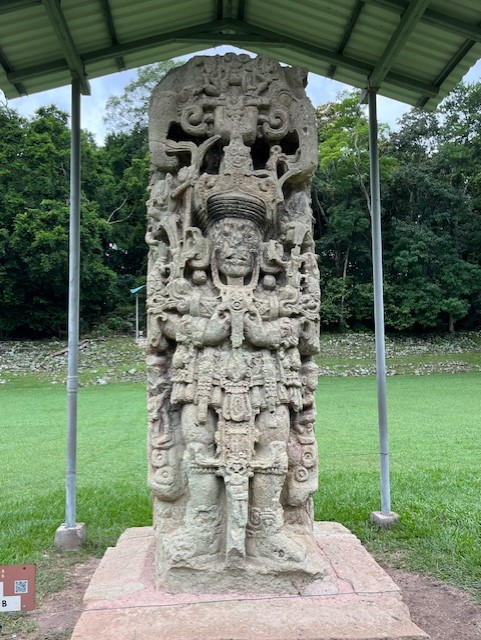
Ornately carved stellae from Copan.
These stellae are elaborate and intricate especially as compared to the “flat” stellae from Tikal fashioned at the same time. None like those of Copal have been found elsewhere. How was such detail possible with stone tools?
The stellae are spread out in a large field. I could envision “the people” gathering in that courtyard of “gods” to watch their priests and kings performing rituals on the temple heights. These carvings and stelae became war-like and even more adulatory for the last kings—their dying gasp to hang on to power.
Fortunately, Copan exceeded our expectations, because arriving there had been an ordeal. As we boarded in Grand Junction three days previously, I received a message from the driver who was to take us from Guatemala City across the Honduran border to Copan. He was an expat birder and graduate student. We had been communicating for months. He had a sudden, important conflict and had to back out. He said he had made other arrangements with a reliable, local driver.
Because of changed flight schedules, our initially planned one-day trip to Guatemala City had already become two, requiring us to overnight in Dallas. Mary had made a hotel reservation near the airport but when we called the shuttle driver, we had difficulty with his accent. He was impatient, rude, and hung up on us twice. We spent a disturbing hour before realizing that our reservation was near the wrong airport. After cancelling the first and finding another hotel, even though it was on a hotel row, none had restaurants.
The next day was worse. Guatemala requires a tedious, online “declaration,” mostly regarding identity. After submission, a QR code, which you must have to board your flight and enter the country, is emailed. I completed the form and dutifully included accompanying family members as requested, erroneously thinking that took care of Mary. Nope. We had to complete Mary’s form while detained at check-in at the airport. We entered it three times, having much consternation while we kept one eye on our departure time, before realizing that Mary’s acknowledgements went to spam while mine had not.
As we landed in Guatemala City, I had eaten an apple, knowing I could not bring it into the country. Unfortunately, enough of its essence remained in my backpack. The Guatemalan customs dog took notice, and I had to be searched. When we finally emerged from the airport, the skies were overcast with light rain.
Our driver, Etsduardo, was waiting. He had a good car and drove safely but was taciturn in Spanish and spoke no English. Our online research predicted four-to-five hours to reach Copan, under four if traffic was light. Etsduardo said it would be at least six. He was right.
Admittedly, it was difficult to have a nice impression of Guatemala City when stuck in traffic on a gloomy day. I was surprised at the number of late-model, large, expensive cars and trucks and the plethora of businesses common in the US: McDonalds (in particular), Walmart, Taco Bell, Home Depot, and Shell. Interspersed with the nice vehicles was an eclectic mix of ancient vehicles and an enormous number of semi-trucks.
The road to Copan was in good condition, but after we had traversed it twice, we deemed it the ugliest road in the world. The drive is approximately 140 miles. Hence, six-hours of travel time equates to slightly more than twenty mph. You may be thinking this was one of the frightening, mountain-hugging, winding roads famous in Central and South America. Nope, this road was mostly straight and flat.
Instead, it was like driving a hundred miles of decaying strip mall. Traffic was heavy. There was an extraordinary number of gas stations, necessary to feed the glut of idling cars. We would pass McDonalds and a Guatemalan fast-food equivalent, and junked cars, other businesses, homes, abandoned buildings, more junked vehicles, and repeat and repeat.
Where there wasn’t a building, there were billboards—many of great size and so close together that the countryside was not visible beyond. Street venders constantly walked in and out of the traffic. Worst of all, it seemed every 100-200 meters there was a speed bump. We were accustomed to these. It is a game on roads in Mexico where warning signs and their appearance were capricious. As soon as I stopped watching for one, I would bang into the next. There would be one at most school crossings, but not all. Usually, these were only an inch or two high and hitting one was only a minor jolt. On the road to Copan, however, each “muerto” (dead body) as they are often called, was 4-6 inches high and two feet wide, causing each vehicle to come to a nearly complete stop every time one was encountered.
You can sense what we experienced: brief acceleration, braking as traffic is approached, slowing to a stop for the speed bump, lurching up and over, and repeat. Often enough, traffic came to a standstill because someone would want to make a left turn or simply be stopped to conduct business from the road because there was no parking. Then we would sit until our driver, taking advantage of the slow, heavy traffic, would nose into the oncoming lane to pass. Horns honked incessantly.
I had worried about a border incident when crossing into Honduras, but passage was simple. Border attendants asked us to open the trunk and peered into a suitcase but then waved us across as Mary and I held up our passports. I asked Etsduardo why they had not stamped them, but he only shrugged. We learned later this was his first trip across the border.
Mary had found a beautiful, bright, and comfortable, boutique hotel. It probably cost triple or more than other local accommodations, but three nights with breakfast in a flower-bedecked courtyard cost about the same as one night in Dallas with no meals. And, important to us later, they had a generator.
After check-in, we went in search of an ATM to obtain lempiras. The streets were deserted. We had no luck finding one. Then, we noticed a group of six or seven heavily armed young men, city police. We asked, being sure they would know where to direct us, but expected a sullen response. Instead, they were friendly and jovial, happy to have anything to do. They conferred. Then with a pleasant smile, three of them waved to us to follow. They waited while we completed our transaction, pointed us in the direction of the restaurant we had selected, and wished us a good evening.
The young lady at our hotel’s front desk had suggested the restaurant. We liked it so much; we ate there twice. Our meal that first night was hearty chicken/tortilla soup, chicken sautéed in local cacao sauce, vegetables cooked perfectly, mashed potatoes, and handmade corn tortillas. I had a beer and Mary a large mojito. All this for less than $30. Now we were excited, travel struggles forgotten. We had read and studied much about Copan and were anxious to visit in the morning.
Local travel was by three-wheel scooters called tuk-tuks. None of the streets were paved as we know it but were made of cobblestones. On the steep bumpy streets, it felt as if the tuk-tuk might flip over backwards when we ascended or be unable to stop on what felt like too-rapid descents. We asked about accidents but were assured that almost none occurred.
A trip anywhere costs the equivalent of a dollar. Tuk-tuks had room for three, but drivers often crowded in a fourth resulting in close encounters with locals who were invariably friendly and happy to speak with us.
After spending three days in and around Copan, we estimated there had been no more than twenty foreign tourists. It was the off-season, Honduras has a bad reputation, and the ruins are difficult to access. We were told that if one flew into the Honduran capitol of Tegucigalpa, travel time by car was longer than from Guatemala City. No wonder the residents were happy to see tourists.
We had an exciting day exploring the ruins, enlivened by large groups of Scarlet Macaws. We had a major surprise when we returned to town. It was November 1, “the day of the dead.” In the main square, four Mayan-featured men in rough, white robes were performing a ceremony with much bowing, incense, and chanting. There was a pile of corn, squash, and beans. We could understand a portion of the chanting thanking “El Senor” for the cosecho or harvest. There was also mention of Pachamama or Mother Earth— an example of the combining of pagan and Christian traditions. We also noted that a stage was set up behind the ceremony. On the stage was a sound system, marimbas, an accordion, and a guitar.
When we returned after a time at our hotel, it was a party. The previous night’s deserted streets were bursting with people. Although stationary at the time, there was a pair of the tall puppets that you often see in Latin America parades. Tables were set up in front of all the businesses. Food, candy, and small toys were being distributed to long lines of mostly, but not exclusively, children.
The city square was about the size of a U.S. city block. A side street off the square had one block’s worth of restaurants and curio shops on both sides of the street. On streets adjacent to the tourist area, there were old ladies selling garden produce, boiled corn on the cob, and churros. A lengthy line of people waited to buy fresh tortillas from an ancient Mayan-featured, woman.
That night we ate at an old, authentic restaurant on a side street. Photos on the wall indicated the restaurant had been operated by the same family for generations. I was reminded again of how everywhere, so much of life, is the same. Honduras has a reputation for crime, street gangs, and corruption but there are families with histories just like ours. Most citizens want the same things we do.
For an appetizer, we ordered anafre, which I called Honduran fondue. There’s a vase-like receptacle with a clay base containing glowing charcoal. A separate clay bowl, filled with refried beans and melted cheese, sits on top. The beans and cheese are consumed with sturdy, home-made tortilla chips. Food overall was familiar to any Latin American traveler, beans, avocados, and chicken or pork cooked in a sauce. After eating, we returned to the square.
The square’s center was packed with tables and a large buffet of food had been prepared. Tables were numbered so we supposed reservations were required. The entire town, it seemed, had gathered to eat, and listen to the band. The guitar player was notably tall for a Central American and played a noticeably big guitar. He was the band leader and was really enjoying himself.
Vendors selling food and drinks crowded the sidewalks. Rows of chairs faced a building’s wall where a movie was being projected to entertain small children. Those slightly older were running around as they do everywhere while adolescents huddled in familiar-appearing groups of mixed gender. We enjoyed feeling solidarity, maybe not directly with these inhabitants, but as fellow members of humanity.
We found seats and listened to the band. One tourist group walked by and then two young, Anglo women we had seen at the ruins. That seemed to be the only tourists about, especially judging by the restaurants, which were virtually empty; we ate by ourselves two nights.
On the following day, we explored a minor group of ruins. There was a large complex inhabited by what were described as craftsmen. I suspected the largest and most ornate belonged to the brilliant carvers for which Copan is known. It had been fortunate the previous evening had been dry because the rain was incessant. This was the afternoon we ate our best tamale and brownie.
That evening, again, the streets were deserted. Perhaps because of the heavy rain, the power went out. We learned this was a frequent occurrence and it might be days until electricity was restored. Our hotel and the restaurant we selected both had generators, but it was eerie to walk through the wet and dark empty plaza that had been so full of life the evening before.
We were sad to leave to leave the next morning. We felt very safe. Our hotel, the food and everyone were lovely. There being few English speakers, we had enjoyed using our Spanish, once talking with a woman who was trying to inspire her grandkids to do homework, something to which we could relate. With another day, we would have hiked through unexploited forest to an area where the ruins haven’t been excavated. We could have made another visit to the “place of tea and chocolate.”
Twenty-four hours later, I was thinking that in a perfect world, Mary would not be sick in our cave-like room in Antigua. The return drive was mostly in heavy rain under dull skies. It was brutal, and an hour longer because we had to go past Guatemala City to Antigua. The drive was also late starting because of an apparent border scam.
On our first full day in Honduras, the attendant at the ruins told us his machine had denied our credit cards. I paid with cash and then checked on the cards later when we had internet at our hotel. The cards were fine. I decided either the government or local workers trying to secure a bit more funding were to blame, but now, as we tried to leave, we learned we had never legally been in Honduras.
Why weren’t we in Honduras? Remember our entry to the country? We had arrived on a rainy, dark evening. Mary and I were enduring our fourteenth hour of traveling, much of it exasperating. At the border they looked in suitcases and waved us by even as we held out our passports. I had asked our driver about passport control. He shrugged and said something about “down the road.”
It is worth an aside to say that in Costa Rica, a few times, we have crossed into Panama to access stores without border control. We assumed this border was similar; that few foreigners cross here and travel further into Honduras. Passport control could be on the other side of Copan Ruinas. Consequently, we were not worried about it.
Well, it was a problem on our return. At first, we blamed our driver’s inexperience with the border but then we realized border officials had let him cross back into Guatemala the day he delivered us and then back into Honduras to pick us up without stamping his passport. Now they wanted to fine him, as well as us.
We wasted one and a half hours with different officials. I decided it was a Honduran scam. Let tourists in, then fine them when they leave for not having their passport stamped. While we argued and waited, we watched numerous vehicles with Guatemalan plates waved through in both directions.
I was surprised how confident my Spanish became when angry. I told them it was a scam. I told them their employee had waved us in, how could we know what to do? We were taken to see a higher-ranking official inside a glass-enclosed office. He was insulted by my argument and kept explaining how passports had to be stamped at every checkpoint. I insisted it was their fault. We had held up our passports at the checkpoint, their employee waved us by.
By now we recognized there was a building where we could have parked and entered where our passports would have been stamped. The building was not signed, only colored blue and white for customs. Maybe if it had been light and not raining? Or if our driver had known? Or did they wave us through purposely?
We were told the fine was approximately $800 which included our driver’s penalty because he had no money. They wanted lempiras which we had been careful to spend. Where is an ATM? I asked, having finally given up.
We were told to walk into Guatemala, while the car remained in Honduras. There was an ATM, but once there, it only had quetzales, the Guatemalan currency. I frustratingly retrieved my card without withdrawing anything just as “El gran jefe” from Honduras arrived, chasing after us. He was overweight and out-of-breath, but pleasant and conciliatory. He told us he had cancelled the fine.
Back at the crossing, we were lectured first by a Honduran and then a Guatemalan, who finally returned our passports. That’s why we have no official record of having been in Honduras. Later, an ex-pat, who frequently crossed into Honduras without having his passport stamped, told me our not being submissive might have been the difference. Perhaps, the border officials had decided we were the sort that would complain to the embassy and write about our experience on Trip Advisor. We will never know. At least we were officially and lawfully back in Guatemala.
Why Guatemala? It had been in the back of my mind for a long time. I recall a childhood game that showed countries and their products. I liked bananas, so maybe that was why I remembered Guatemala —like I remembered reading about Venus and Neptune when I was a child.
As an adult, I had read Bitter Fruit and other books about the country such as I, Rigoberta Menchu, Bird of Life Bird of Death and travel books such as Green Dreams and Guatemalan Journey. Besides, when we were at Uxmal, we heard a tourist say to a guide, “I’ve been to Chichen Itza and now here, I guess I don’t need to see any more Mayan sites!” The guide replied, “No, you have to see Tikal.” We already knew that. * And, then there’s the Pink-headed Warbler. More about that later. Anyway, Guatemala and Tikal had been a dream for years.
The unfortunate border incident was just what we needed at the beginning of the seven-hour brutal drive! Unfortunately, our travails were not over. Etsduardo dropped us off on a crowded street in Antigua and pointed at a doorway. We bumped and bounced our suitcases over to a small desk just inside. After several minutes, the attendant said they were full, and we did not have a reservation. I explained that our birding guide had made the arrangements and gave her his name. That didn’t help. I called Daniel. He was in the field with clients but took the time to talk to the attendant. She seemed satisfied and hung up, but after several minutes still could not find our room. She went for help.
After conferring for more minutes, the two clerks informed us this was one of several hotels with the same owners and our reservation must be at a sister facility a couple of blocks away. Dutifully, we trundled our suitcases down the rainy, cobblestone streets to the other hotel. I was engaged in talking to the attendants. Mary was engaged in looking about. She told me later; she would have refused to stay there. It was busy, small, crowded, and untidy—not our kind of place, particularly for three nights. She did not have to voice her concerns. The woman at the desk also went for help and brought out the manager. He said we did not have a reservation but surely had one at the place we had just come from. Back onto the rainy cobblestones we went.
I called Daniel again and he persuaded the attendant to find someone else for him to talk to. She went for help and finally our reservation was found. They were apologetic and blamed the confusion on a new employee. We had just lost another hour.
We were given keys, passed the attendant’s desk, and entered a hallway which opened onto a courtyard with many plants, tables, and chairs. Our room was tucked back opposite the courtyard. We were so relieved to finally have a place to crash, that we did not look carefully at the setting. We should have asked for a second-story room. Ours was cave-like, the only window opened onto a dark walkway with the courtyard behind.
The hotel’s location was near the main square and the most well-known of the historic buildings. But like every building in the city center, it was 300-500 years old. With the tile construction, every sound was amplified. Facing that interior courtyard and adjacent stairway to the second floor, we heard every sound. We could hear the voices in the next room and chairs scraping anywhere in the building. As the night wore on, people returned from their evening excursions and often sat in the courtyard and conversed.
We had been disappointed with the restaurant we selected, finding on arrival it was a street cafe with benches outside without the relaxing ambience we needed. We were too tired to look elsewhere. Then, it was a long, noisy night culminating with Mary’s early morning attack of intestinal trouble.
We have both faced this malady before (See, The First Time and More, Learning to be Travelers). Mary started a regimen of the antibiotics we always have with us, but she was miserable. Nothing stayed down or in. I could think of other locations where we had endured illness. None were this dark, this noisy and this damp.
She encouraged me not to stay in the dank room. There was nowhere to sit except on the bed or in the courtyard, so I ventured out. A local had told us, “You google Guatemala, you see three things: Antigua, Lake Atitlan and Tikal.” Our arrival with Mary starting into her illness after an awful day of travel and the hotel mix-up did not set us up to enjoy Antigua despite its quaint cobblestone streets, old public buildings and historic cathedral.
It did not help that it was a busy weekend, and that traffic was not restricted. Cars and motorcycles were everywhere. The one-way street in front of our hotel had cars side-by-side, two abreast, bumper-to-bumper, frozen in traffic the entire day. The weather was so heavy (rainy or foggy), vehicle fumes did not dissipate and were very noticeable as I walked about.
It also did not help that we were across the street from “Pappy’s Bar BQ.” In fact, it seemed all the large seventeenth century courtyards inside what were once mansions are now food malls or artisan malls. If you sum up what is behind each door on the quaint streets, nothing is missing: sushi, organic, Irish, vegan, spas, massage, jewelry, clothing, travel agents, 4-wheeler rental, Vietnamese, Indian…and so on. It is a trendy mega-strip mall. Taking your time and being “into” different foods would be a reason for being in Antigua. As for us, Mary’s recovery was aided by a nearby US-style smoothie shop. Indeed, Antigua reminded me of the great Castle of Carcassonne in France where the building is magnificent, but every space has a shop employing a method for extracting tourists’ money.
Antigua has a beautiful old square fronted by an historic municipal building. Both were scenic but filled with vendors of every stripe. Most, apparently, were Indigenous, based on their clothing and features. Most were selling junk while eating pizza from Dominoes. I suspect certain of the vendors’ wares were authentic, but how could one tell? Hats, jewelry, food, weavings, art were everywhere. Others wanted you to take photos and pay for them. Still others seemed desperate, selling items (gum, cheap toys) no one would ever buy. Where did they come from? We wondered what happened at night. Where did they go? After dinner one night, many doorways were full of the Indigenous. Did they sleep with their wares?
I walked up to an overlook/park. With the historic architecture below and the surrounding volcanoes, the “bones” of the old city are scenic and charming. The setting is as beautiful as the touristy photos show. I also found three new bird species in the park. We would have enjoyed a day walking around but would still have been glad to move on.
Our last afternoon in Antigua, we were to be met by my birding guide, Daniel, who had been recommended by a Costa Rican friend as “the best guide in Guatemala.” Five days later, Mary and I easily agreed that our friend had not exaggerated.
Daniel had been guiding twenty-four straight days. He had asked me if he could bring a guide he was training. Erika is a biologist planning for a career as a general nature and adventure guide. We were glad she came. She was knowledgeable, enthusiastic, and always helpful.
There was also an authentic restaurant that Daniel showed us. Traditional foods are often served in bowls. From the menu, you expect a piece of chicken cooked in a particular sauce with the sides of vegetables served on a plate. Instead, you find them all cooked together and served as a stew with corn tortillas on the side. We found these meals tasty and satisfying.
Mary’s condition had improved, but she was unable to accompany us for lunch or the afternoon excursion. Our first stop was El Pilar, private land, but protected as Antigua’s watershed. I recalled the same situation near Manizales in Colombia—the only reason a large area was not deforested was to preserve clean water. Fortunately, wildlife is preserved as a byproduct.
Two birds I had hoped to see were present: Rufous Sabrewing and Bushy-crested Jay. It was a great area for hiking and the views from the mountainside were superb.
Mary had finally recovered sufficiently to join us for a light supper. If there was a positive side to her illness, it was that it had not affected Copan and would not affect our plans for Lake Atitlan and Tikal. She was ready for our 4AM departure the next morning—a morning in which I hoped to see a Pink-headed Warbler.
The whole truth is that as much as I wanted to visit Copan and Tikal, the trip would not have occurred without the opportunity to see a Pink-Headed Warbler. Four years previously, I went on a commercial birding group trip to Chiapas and Oaxaca. My most desired bird was the Pink-headed Warbler.
Guatemala and Chiapas have remnant pine forest—the most southerly pines in the hemisphere. Pink-headed Warblers are confined to the highest (cloud forest) portions of that habitat. They were never widely distributed geographically and are threatened with extinction by both deforestation and climate change. Mexico already lists it as “in peril of extinction” and likely has a larger population than does Guatemala.
Unfortunately, local unrest prevented me from seeing it in Chiapas. Our guide had been scouting for them the week before the group trip. He was threatened and chased. Sadly, while our group was in Chiapas looking for other birds adjacent to the Pink-headed Warbler habitat, men within fifty meters were denuding the slope we were birding with chain saws. Probably, a week later, the area where we saw several interesting species was cut down. The good side of that sad news is that the Chiapas/Oaxaca trip was well worth it anyway, and not seeing the Pink-headed Warbler became a justification for going to Guatemala.**
Our destination that morning was Finca Caleras Chichavac, an old farm. The owner only “selectively” logs the property and invites ecotourists. I did not understand the relationship, but several Indigenous people live in their traditional ways on the property. They wore their native clothing and tied their babies to their backs with long cloths.
The early morning was foggy and rainy but began with a good omen. As we parked the car, Daniel pointed at a distant conifer. That’s a Hooded Grosbeak! It was one of my most desired species, a rare one I had missed when in Chiapas and Oaxaca. Through the scope we had excellent views.
Our good luck continued despite, or maybe because of, the rain. Daniel told me later he feared we would not have a good view of a Pink-headed Warbler. Usually, they are in the treetops, he said. I feared you would see little more than a shape. Instead, to avoid the fog, two came in close and only a few feet off the ground. The rain had briefly ceased, and I was able to otain excellent photographs.
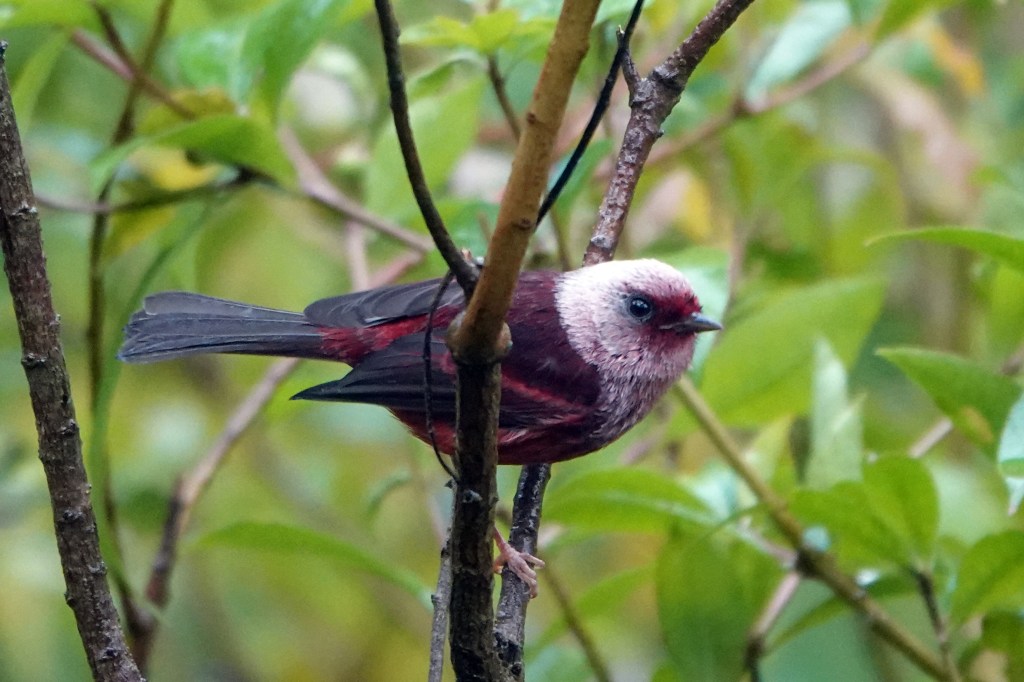
Pink-headed Warbler
Hours later, as we were walking back for breakfast, Daniel turned to me and said, “Have you heard of Alexander Skutch?” “Are you kidding,” I responded.
Skutch is a hero of mine. He was an ornithologist and thinker to which I devoted nearly all the second chapter of my book and quoted throughout. I own all thirty-one of Skutch’s books. I knew he had spent time and written of experiences in Guatemala. Now I was able to have breakfast and tour the very farmhouse where he had lived. This was better than a new bird! I might have eaten breakfast at the same table!
I reread Skutch’s account of the area when we returned home. In his day, avian life was much richer and included Horned Guans and Resplendent Quetzals, both endangered and neither living nearby anymore.
From there we drove to Lake Atitlan where we would spend three nights. Before arriving at our hotel, we stopped to see an unusual hummingbird, the Slender Sheartail. Parking at a farm, we walked under a sign indicating we were entering a bird sanctuary. A rough path routed us past three or four Indigenous who were selling food, drinks, and crafts. Daniel told me guides had known about this location for the Sheartail for years. Eventually, those living and working on the nearby lands erected the sign, charged access, and started vending. I liked the straightforward way birding was adding to the local incomes.
Lake Atitlan is postcard beautiful. Our base was Santiago de Atitlan, one of the twelve villages on the lake. Some villages are only accessible by boat. No road circumnavigates the lake. Tourists take boat excursions to visit these villages to sightsee and shop. Native dress is not a show for the tourists here. It is authentic. Daniel and Erika told us that Guatemala’s twenty-two identified Indigenous groups mostly use traditional ways and clothing.
Mary hired a tuk-tuk and visited a local market one morning while we were birding. There were no other gringos. She did not visit the artisan market where it is possible to buy authentic weavings. Judging by the clothing we saw; the people are experts. We did not take the time to go to that market, not being interested in more things to hang in our house. Here, there were no McDonald’s. Apparently, the US economy has not penetrated beyond Guatemala City, and that stretch to Copan.
Often, I write of missed opportunities and bad luck. Not this time. We saw the birds I desired most and all but one of the others I had hoped for, but it was not easy.
Seeing a Horned Guan pushed me to the edge of my seventy-four-year-old ability. We were on the trail at 4AM. The plan was to climb 2000ft in two hours and arrive at first light where there was a fruiting tree favored by the guans. There were three besides me, Daniel, Erika, and Arlo, a local guide.
Although, I had not run a race in years, my training and experience helped. I began deep-breathing before the climb started so that I would not run out of breath quickly. I scanned every step as we climbed, watching to ensure that I raised my foot the minimum necessary. Whenever the slope moderated, I continued breathing as deeply as I could so that I could maintain and restore my breath. Later, I received compliments for being a fast hiker.
I learned that Arlo roams the upper portions of the volcanoes that surround Lake Atitlan searching for fruiting trees that attract Horned Guans. The forest and understory vegetation where the guans live is thick. The volcano slopes are very steep. Daniel said the only reason the guans persist is that the volcanoes are high enough and access difficult enough that local people do not climb up and shoot them for food.
Arlo’s reconnoitering paid off. We could hear a guan’s deep-nasal call, but it was not in sight. With my inability to triangulate sounds, I would never have found it, but Arlo and Daniel soon pinpointed the location. We had to slide into a steep ravine. We scrambled and finally, Daniel and Arlo, told me to wait. A few minutes later, they returned having found a “hole” in the vegetation through which the guan could be viewed. This bird is so rare (~1000 remain) and its habitat so unfriendly to humans that it is almost mythical. I indulged myself as I watched it feed. What a strange looking bird: gawky in profile, orange feet with long, finger-like toes, overall dark-bodied but with white undersides, a pale blue eye ring and a cream-colored beak with significant overbite that seems to curve from the nostrils. And then there is the horn. If you can visualize a pinky finger separated from the rest of a hand and enclosed in a red examination glove and glued on top, that’s it! We were only a few days past Halloween, this was a bird that appeared to have forgotten to remove its goblin costume. Now it was time for breakfast.
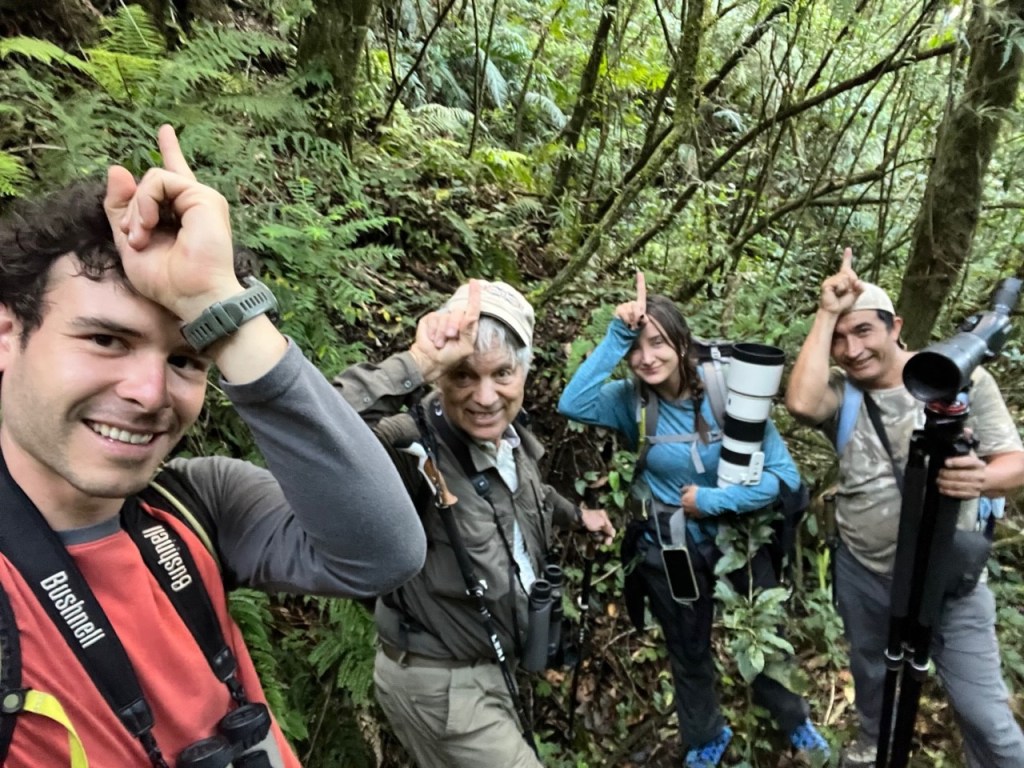
We are signifying our success by showing the horn!
Arlo’s wife had prepared fresh tortillas and chicken and eggs in a tomato salsa. He unwrapped this feast from banana leaves he had carried in his pack. As I ate, I thought about my good fortune to be a birder. Sometimes, all that is needed is the energy to walk a few feet from a parking lot and watch a favored perch as with the Slender Sheartail. Sometimes, a muddy, 6AM hike is needed as for the Pink-headed Warbler. This was more. Accomplishing hikes such as this justify my efforts to stay in shape. I had just seen one of the rarest and oddest species on the planet. Now I was sitting on the slopes of a classically formed volcano enjoying the same breakfast many Indigenous families were having in the huts far below. All of this while I gazed through the trees at Atitlan, one of the world’s most famous lakes.
More about Arlo. Being the one with the mountain legs and lungs, he carried Dani’s scope, the food, the water, and snacks—thus, he had a big load on his back combined with the awkwardness of carrying a scope in his hands. Without all of that, we could not have kept up with him.
On the following day, we hiked up and around on the volcano slopes. Arlo came with us to help spot birds, which he was exceptionally good at, to carry gear, and provide breakfast. Arlo brought his 9- or 10-year-old son, who sat and watched the vehicle when we were away from it. It was sad that the vehicle needed to be watched, but that is common enough anywhere these days.
Why wasn’t Arlo’s son in school? I wondered. Daniel said the state schools are notoriously bad. He himself, with educated parents, went to private schools. Considering how poor everyone is, this guiding and provision of breakfast may be a big part of Arlo’s family’s income. I know that Daniel had employed him three weeks before and was coming back in a couple more weeks. I don’t know what Daniel paid him because local guides were included in what I paid for Daniel’s services. (I also tipped Arlo separately.) On the other hand, Guatemala is not a major birding destination. A couple of companies do have trips there. Whether Arlo is the only one doing this at Atitlan, I have no way of knowing.
Although we had overall good luck birding our last day at Atitlan, there was the one species we missed—Yellow-throated Nightingale Thrush. Daniel had seen it three weeks previously. In the interim, locals had cleared the ravine where the bird had been accessible…in a national park. All the peaks we could see are part of a national park system where there is no enforcement. Wood cutting was occurring all over the lower slopes, even of tiny trees, a practice especially symbolic of the poverty. Meanwhile, more birds and other species, such as a couple that I came to see, are threatened with extinction.
The ravine where we had hoped to find the nightingale thrush had been planted with an invasive, large-leafed plant used for wrapping food. Daniel said gatherers receive only a few centavos for collecting them. We have been in impoverished locations in several countries, but in Guatemala, it was more consistent and pervasive than anywhere else we have been.
I seem to be criticizing Guatemalans for wanton environmental destruction but mix desperate poverty, lack of education, and lack of governmental enforcement…what else could happen? Daniel and Erika also said, most of the Guatemalans who emigrate to the US are from the villages, not the city. In the rural areas, too many of the resources are exhausted and there’s no land for the next generation. Starve or leave…just as Paul Ehrlich predicted in the 1970’s.
In addition, it was only a couple of decades ago that their government, with initial support from the US, determined that every Indigenous person was part of the left-wing opposition. The result was genocide. Santiago had hundreds of “disappeared.” A US Catholic priest, in Santiago de Atitlan, who was helping the Indigenous, was gunned down in the streets by the Guatemalan army.
I asked our guides what they were taught in school about the US-backed coup in 1954 which wrecked their budding democracy and turned the country into chaos. The book Bitter Fruit describes the 1954 debacle in which United Fruit Company, fearing a loss of profits, falsely claimed that a workers strike for a livable wage was Communist inspired. This was the height of the red scare period and Eisenhour had the right-wing zealot Dulles brothers in his cabinet. United Fruit leaders convinced the Dulles brothers, who convinced Eisenhour, and the US helped depose the Guatemalan president and replace him with a military junta.
We had an interesting discussion. They knew about 1954, but a more recent wound described by our friends is that in the 60s and 70s, the CIA, with the consent of the right-wing dictator at the time, injected political prisoners with diseases our troops in Viet Nam were contracting in order to devise treatments. One of our guides had a relative who died from this. I continue to wonder in many of these countries why the inhabitants do not knock all of us on the head when we show up. Fortunately, they do not blame individuals, they blame our government—and the country is desperate for tourist dollars.
The lack of organization and leadership (and money) can be seen all over. Daniel remarked while waving at the lake, “can you imagine how much money Cost Rica would make from this lake…jet skis, zip lines…etc.” Some of that would certainly make sense if it were controlled. Lake Arenal in Costa Rica has those diversions and solid protection for the park areas that surround the lake. What if the government had invested in tourism and jobs infrastructure a few decades ago instead of genocide? (You still see lots of army presence, roadblocks, trucks with soldiers driving around, etc.)
On our final evening, we sat overlooking the beautiful, tranquil lake. Mary had a glass of wine. I had a tumbler of Ron Zacapa, a local rum which had been the answer I was given when I asked if there were a drink or product for which Guatemala was known. The scene was mesmerizing, an enormous (50sq mi, average depth 500ft), calm lake surrounded by the triangular shapes of volcanoes rising 4-5 thousand feet above the calm surface.
Our hotel was perfect, comfortable rooms, tasty, authentic food, nicely landscaped grounds, and a lakeside, perfect for watching the sunset. Watching the Indigenous sculling their skiffs across the lake surface in the fading light was a highlight. Unfortunately, we knew too much. Bass were introduced decades ago. The bass not only wiped out the native fishery, but also caused the extinction of a flightless grebe that had evolved only in this lake. (Bass love to feed on small birds floating on the surface.) The Indigenous people, with no tradition and taste for bass, do not fish for them or eat them. We had seen pipes pouring wastewater directly into Lake Atitlan. There have been lake-wide cyanobacteria outbreaks due to unchecked pollution.
We saw in another location, twenty or so women who had waded into their waist and were washing clothing—a quaint and charming sight but, as Daniel said sarcastically, “and isn’t that great for the lake?” (Daniel is an upbeat person. It is just that his profession confronts him day-to-day with the ongoing environmental degradation. He also guides in Costa Rica and sees conditions that, while not perfect, are much better.)
The constant political turmoil has led to an evangelical takeover of religion from the Catholicism that had been identified with the right-wing, genocidal, leadership. There are thirty-seven evangelical churches and five Catholic in Santiago de Atitlan, a town of 45,000 people that is almost 100% indigenous Maya. Every night there were big fireworks displays, the kind that cost thousands of dollars in the US. This was right across from us—4th of July, every night, just after sunset, fireworks reflecting off the lake’s mirror-like surface. I asked who was responsible and the answer was that it was one of these churches. Extract money from the poor and then use the money to shoot off fireworks!
I was reminded of a short story by B. Traven, “The Kidnapped Saint.” A destitute Indian had used the last of his money to buy votive candles to pray for a saint’s intercession, initially for his sick mother and then in the hopes of obtaining work. After his hopes were dashed, he stole the saint’s statue and hung it in a well. He hoped such treatment would cause the saint to relent and give him what he needed. The Indian eventually dies leaving the statue to be discovered later to the wonderment of those who found it hanging in a well.
Enough negative thoughts! Guatemala has marvelous historic, traditional, and environmental resources. Hotels, guides like Daniel, the weavers who are selling at the market, need tourists to come. If there were enough tourists, there could be enough protection and Resplendent Quetzals, and Horned Guans could again be seen at the base of these volcanoes.
The birding had been magnificent, but Mary and I were rundown. Each day had meant waking at 4 or 5 and going hard. We were looking forward to Tikal, but we had one more stop to make, a multi-generational, long-time, coffee farm, run by a German family: Los Tarrales.
What a wonderful place for birding groups! All we had was a morning, but we saw deer, flocks of Collared Aracaris and other birds. A perfect volcanic cone overlooked the property. There were no new birds for me here, but I enjoyed filming an Ivory-billed Woodcreeper and seeing a Great Black Hawk fly over. There was a swimming pool and nice grounds. I would return. From there, Daniel and Erika dropped us off at the airport for our flight to Flores where we would catch a shuttle for the hour-plus ride to Tikal.
We had already endured three frustrating days of travel. It was time for more. This story has a successful conclusion, but not without our having to experience significant mental distress. Although we were six hours early, we went to check in with TAG airlines. No one at the counter spoke English, but they communicated easily enough that our flight to the city of Flores was not going. Mechanical problems! They said. When could we go? No one knew. They looked at each other and shrugged. Wait! is all they said, so we did.
Three hours later, we were told there would be a flight at approximately eleven PM. We asked how long the flight would take. The two attendants looked at each other and shrugged. When will we arrive? I asked. Again, nothing. One went in the back for a few minutes. When she returned, she said, We think forty-five minutes. There are three or four flights to Flores per day. How could they not answer such simple questions?
The late arrival meant we would miss the hour plus shuttle ride to our hotel at Tikal. Mary and I frantically attempted to communicate both to Flores and our hotel. Would anyone meet us? Could a ride be arranged? Would someone be there to let us in our room after midnight? We were never able to receive firsthand information but decided we had to get to Flores, even if it meant staying in the town for one night.
We sat there fretting and aggravated. Meanwhile, the departure board continued to update TAG flights, but none were for Flores. Flights to other cities, including some departing the next morning, were posted. Why not ours? Finally, I decided to check if there really would be a flight that night. Again, my presence caused consternation among the three attendants. One finally turned to me and said, You must hurry. The door for the flight is about to close. I ran for Mary, and we ran for the gate. We were among the last to board. We waited eagerly for the pilot’s announcements to ensure the flight was actually going to Flores.
Ironically, the twin-engine plane was spotless and modern. The flight attendants were professional. Our luggage was on board, and our arrival in Flores was earlier than our original schedule. Of course, our hotel had thought the flight had been cancelled, so our shuttle was quite late. Nonetheless, after all the anxiety, we were relieved when we finally arrived at The Jungle Lodge at Tikal.
Unlike Chichen Itza, where copious vendors mar the experience, peddlers and their wares are not allowed inside the park where it is a twenty-to-thirty-minute walk to any of the structures. Regrettably, labeling and signage were poor compared to Copan and what we usually encountered in Mexico. Copan’s museum is also much better than Tikal’s, the latter of which, while interesting, was composed mostly of photographs. Nevertheless, Tikal did not disappoint us.
Settlers from Tikal are believed to have initiated the Mayan influence (there were already farmers present) at Copan which is about one-quarter the size. Indeed, Tikal was the dominant Mayan city for several hundred years, although Calakmal and others were as powerful.
The temple complexes for which Tikal is known are astounding, especially if one imagines them with the original garish colors. The hieroglyphic record is also strong, describing history and honoring the rulers with stellae, altars and temples. During the seventh century, the Tikal ruler was captured and sacrificed by the city-state of nearby Caracol causing a hiatus of more than a century in Tikal’s hegemony. All of this can be visualized by the timing, quality, and quantity of structures.
Initially we hiked to one of the minor temples and then followed the trail to the main plaza.
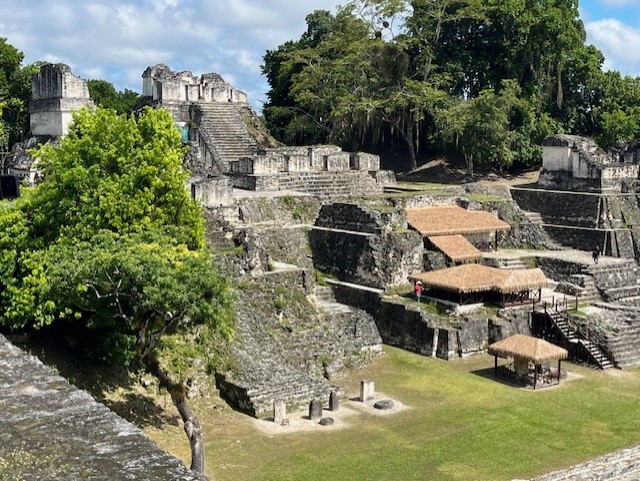
A portion of Tikal’s Central Plaza
Even with a lot of people there and the tour guides doing their claps*** in front of the pyramids, it was breathtaking to contemplate what it must have been like. There were two large temples facing each other over a central plaza. On the other sides of the plaza were large complexes, the North Acropolis, and the Central Acropolis.
We had no difficulty filling out our day inspecting the buildings and sculptures. We were well-prepared to visit the site and enjoyed reconstructing the history and visualizing how life had been for the Mayans. With our preparation, we did not miss having a guide, but, nevertheless, soon wished we had more time.
That night, we viewed the sunset from Temple IV. For this, or for a sunrise view, a guide is required. We welcomed having a guide because if your flashlight failed on the way back or you stumbled off the trail, you would be lost. (It has happened.) Walking back at night, the darkness was total. There are no lights, and the jungle is dense. Without experience and knowledge of where things were, it would be easy to become disoriented within the trail system. Perhaps that added to the feeling of mystery.
Our guide, Benedicto, was arranged for us by Daniel. He was an excellent choice and was tipped off that we were interested in birds. He immediately took us to the favorite perch of a pair of rare and near-threatened, Orange-breasted Falcons. There are believed to be only two dozen pairs in Central America and the Peregrine Fund has established a breeding program to save the species. This falcon is larger than the more common Bat Falcon. It was appropriate that Tikal, being such a prominent site, harbored this large, rare raptor.
Once we climbed the ladders and stairs to view the sunset, we were surprised to see that there was probably no one up there within thirty years of our age. It was not that difficult to ascend. Maybe the age difference reflected our desire to travel solo rather than with a tour, as did the younger visitors.
As we looked around, we could see temple crests rising from the thick jungle. It was difficult to comprehend that more than fifty thousand people had lived there and that the dense forest we were viewing had been cut down for housing or crops. I realized that Orange-breasted Falcons probably did not live on the temples when the civilization was at its peak. There would have been too many people and not enough prey. From our vantage point, we could visualize what the first Europeans saw–nothing but mounds with vegetation-covered temple-crests emerging from the forest. It was incredible to comprehend, what was there, what it was like, how it was built and that it all collapsed.****
We wondered. Who were the individuals who built these? What had they looked like? What had they thought of? Even though those questions are being answered in recent years, it was still a place to contemplate the past. What had the ceremonies been like? Did all fifty thousand inhabitants crowd around?
We can visit our Capitol, Washington’s Mt Vernon, or Jefferson’s Monticello and consider 250 years of our civilization. Here at Tikal, it had been six or seven times as long. All that history, all that life! Now, after the sunset tours are done, no one is there. Bats swoop about, Mottled Owls hoot, and the pair of Orange-breasted Falcons rest until dawn.
Our second full day consisted of rain and fog. It was eerie to see the temple crests looming, barely visible, in the mist. We could stand in the plazas gazing at the size and grandeur, but photography was difficult.
As with Copan, we wished we had another day. There was more of Tikal to see, and I had not recognized how good the birding would have been. I would certainly have seen two or three new species with another day. But it was time to go.
On that last morning, we worried in the shuttle all the way to Flores whether TAG’s plane would, indeed, be there. It was, but this time the problem was American Airlines. The counter attendant informed us that our plane to Dallas was going to be late arriving into Guatemala City. American had already scheduled us to spend the night in Dallas. We were also informed that the next morning’s early flight to Grand Junction from Dallas was already full, so we were being routed to Phoenix. Instead of arriving home that night, it would be late the next afternoon.
You might guess what happened next. The flight into Guatemala City made up a lot of the time. More was made up flying to Dallas. When we landed, no other international flights had arrived, and we breezed through customs with sufficient time to catch our original flight. Except! We were now ticketed through Phoenix the next day. We attempted to change our tickets back to the original, but the lines were long. We frantically watched the minutes pass and finally reached the counter. The attendant said, The flight is still here but it is in the next terminal. You won’t make it. I am not allowed to change your ticket.
In the end, our trip encompassed fifteen days. We traveled on six, each of them memorable for problems. Mary was sick two additional days. That left seven; each of which I would describe as perfect. Soon after our return, Mary said she would never have done the trip if she had known about the travel and being sick. However, months later, she agreed, it had been worth it. We would never give up those seven perfect days.
*In our opinion, the best cross-section of Mayan sites would be Copan, Uxmal, Palenque, and Tikal, reluctantly leaving out Calakmal. If it were a single, brief trip, we recommend the central Yucatan (Uxmal, Calakmal), with a side trip to Palenque.
**Apparently, Chiapas residents have now recognized that birders are harmless and have money to spend. They recently had a “bird fair” in the area we were unable to access and are now welcoming birders.
***Mayan pyramids are known for having been constructed such that they magnified sounds from the courtyards in front. Because of this, all the tour guides take their charges to the front of the pyramid and clap. The infernal, never-ending claps became annoying. Plus, neither Mary nor I sensed that much of an effect on sound.
****Jared Diamond, in his book, Guns, Germs and Steel, posits that besides the over-exploitation of the environment, the Mayans failed because there were no beasts of burden or large food animals to domesticate. It was not that Europeans were inherently smarter or more resilient, but the latter had cattle, horses, sheep, and goats. All the Mayans had available were gamebirds. In addition, the Europeans were not as isolated. For example, the Roman legions conquered foreign lands and exacted tribute. The Mayans, deep in the jungle, had significant geographic barriers, such as vast swamps, impassable jungle, or mountains, which prevented their expansion and colonization.
 Birds and More
Gre
LikeLike
Sent again. Sent from my iPhone
LikeLike
All it shows is Gre….. from a weird email addresss
Sent from my iPhone
LikeLike