
The view from Rincon Peak is endless—a hundred miles or more in every direction. You’re an eagle soaring…with a few beats of your wings you take in all of Southern Arizona…shape echoing shape as far as you can see. Janice Emily Bowers, The Mountains Next Door
I was mortified. We had lived in Tucson for six months, having moved from Illinois four days after our marriage. Previously, the furthest west I had been was Central Missouri. I had been insufferable to my Illinois relatives about how wonderful it was in Arizona: the exotic plants, the Mexican food, all the places we could recreate. Most of all, I crowed about the warm and sunny weather. It was December 8, 1971. Nearly seven (6.8) inches of snow had fallen—Tucson’s largest snowfall ever, a record that still stands and the lead story on the national news that night. Of course, I heard about it.
Once the weather cleared, the Santa Catalina mountains that comprise Tucson’s beautiful northern skyline were brilliant white. I had never seen snow-covered peaks before. While still personally embarrassed by the snow, I admired the beauty of the ermine skyline. That storm represented the uniqueness and diversity of our new environment.
We loved it. I earned a graduate degree and was a staff-member at the University of Arizona (UA) for almost seven years. I consider the UA to be my alma mater. We had football and basketball season tickets, the beginning of my lifelong attachment to UA sports. Although we moved eventually, I have always been able to envision a life in which we had stayed. We have lifelong friends (See: Saints Among Us) and have returned often, having done the road trip from Grand Junction, perhaps, fifty times. Part of my spirit will always reside in Southern Arizona.
I can still see the pine-filtered morning light casting everything in a golden glow on one of our first backpacks. The emanation of water vapor from the bark and needles was diaphanous. The needles shimmered in the dawn light. A hummingbird, attracted by my orange watch cap, nearly collided with my nose. It was morning at Happy Valley Saddle in the Rincon Mountains.
Of the four ranges that mark the cardinal directions of Tucson’s skyline, the Rincons are the least visited. They are not penetrated by roads and National Park Service regulations have minimized backcountry visitation.
It was mid-March 1975. We were on our way home; the last morning of a three-night trip. That spring morning was as nice as one can imagine in Southern Arizona…beautiful sunshine, no wind, plants bursting with new growth. We did remark about the high stratus clouds and evidence of winds aloft.
That night a storm moved in. When we looked out from our apartment the next morning, the mountains were white. Several feet of snow had fallen in the high country. Other backpackers had to be rescued.
Our own trip had started on a morning as beautiful as our last. We knew little about the trail although we had good maps. We planned to camp at Spud Rock Spring. The mileages were reasonable but elevation for the hike, as with most Southern Arizona mountain trails was formidable…starting under three thousand feet but ending at near nine thousand.
Later, when we moved to Colorado, although the mountains were thousands of feet higher, so were the trailheads. Colorado hikes seldom required climbing more than 3000-4000 feet but daily climbs of 5000 to 6000 had been common in Southern Arizona.
Before moving to Arizona, I thought the Grand Canyon was the only canyon. I was amazed at all the named canyons in the local mountains—some with trails, many without, all there for me to explore. I studied maps for hours, fascinated by names such as Helen’s Dome, Bear Canyon, Agua Caliente Hill, the McFall Crags. All I had grown up with were muddy creeks, misnamed Silver, and Sugar. Location names were tame such as Schuepbach’s farm or Klaus’s Lake. In Arizona, there were “real” topographic features. I wanted to visit them all.
Our morning on Happy Valley Saddle had started from what we called the back side of the Rincons, because the trailhead required driving around to the east side of the mountains as opposed to the west side that was visible from the city. There is a photo of Mary in a white t-shirt with “Illinois” in dark blue letters. We had not yet worn out the stash of clothing acquired before our move. She is sitting in front of tiny ledges over which water trickled. A small yucca and an alligator juniper are in the background.
We hiked to Happy Valley Saddle easily enough. What a nice campsite, we exclaimed, looking forward to it for our last night. The trail split here—south was the climb to the summit of Rincon Peak, north led into the heart of the Rincons and our destination, Spud Rock Spring, where we would camp.
Camping at Happy Valley Saddle the first night was out of the question. We had already used much of our water. Backpacking in Arizona is usually about water. Where is the spring? Is the spring dependable year-round? Water availability also meant backpacking hikes in Southern Arizona had to be completed. No stopping a mile or two early because there was a nice site, or you were tired. You had to get to the water.
That was why we could not camp. If we had camped there and climbed to Spud Rock Spring the next day, we would have run out of water. On our way back, we planned to carry enough from the spring for a dry camp’s dinner and breakfast, and the hike out.
As often happens, the hike was longer and harder than expected. We should have known. Why had someone named the section from Happy Valley Saddle to Spud Rock Spring Heartbreak Ridge? We would contour within the trees for a quarter of a mile and then behold steep switch backs above. From what we could see, the trail appeared to top out. There was no such thing as a GPS providing elevation in those days. We would reach the top of the slope and there would be a false summit. Again and again, another false summit. Many years later I do not recall a trail which so cleverly hid the ascending ridges until finally we managed the final switchback.
It had been a long day and then it was a chilly night.
Our friend Dave had accompanied us. The temperature dropped and the wind blew hard enough that our little fire was useless. We moved an old fire-fighters metal cabinet, wide enough for two occupants, near the fire. The three of us crammed inside and opened the doors hoping to capture some heat. It did not work. We had adequate tents and sleeping bags—better to go to bed early than be so cold.
The next day was clear and beautiful and many names from the maps became my mental possessions. We viewed Spud Rock and Helen’s Dome and hiked to Rincon’s highest point—the broad summit of Mica Mountain (8668 ft.) We visited the beautiful spring-fed waterfall and pool known as the Devil’s Bathtub. We examined the geology, especially a large area of exfoliating granite. We saw no one else and yet, as the proverbial crow flies, we were about twenty-five miles from the center of Tucson. I thought I had moved to paradise.
Years later, I met someone who had grown up in Texas and had moved to Southern Arizona at the same time. What was your first impression? I asked. Magic! He replied. Yes, exactly that.
In Illinois, my office in the University of Illinois Chemistry Department was in the bowels of a large corridor that lacked any natural light. At the University of Arizona, one of my offices had a view of La Ventana, a large natural arch on the skyline of the Catalinas. I would gaze in that direction, thinking of the hike I would someday do, and eventually accomplished, to climb through that window. From other offices, I looked out upon the Santa Rita Mountains and their highest peak Mt Wrightson (9456 ft). On one memorable occasion, I had camped on the narrow ridge below the peak during a full moon. The next morning, I watched as the moon set and then I pivoted and caught the first rays of the rising sun.
The day we camped at Happy Valley Saddle, we climbed Rincon Peak (8482 ft): pointed, bare rock, but with an unparalleled 360-degree view. The northern view was of Mica Mountain and Mt Lemmon, familiar points on the Tucson skyline. To the south were the Whetstone Mountains towered over by the Santa Ritas beyond. Past the Dragoons to the southeast, we could make out the Huachucas and Chiracahuas. Looking east, just below, were the Galiuros and, on the horizon, the bare outline of 10,720 ft Mt Graham and the Pinaleños. More of those names from the maps were now personal acquisitions.
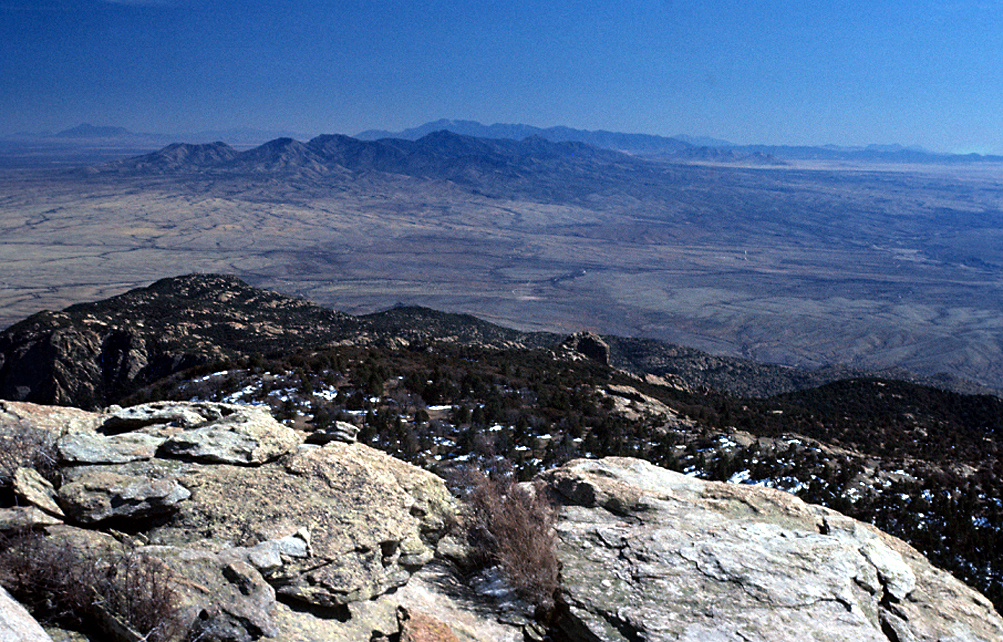
Distant Mountains from Rincon Peak
We had many such trips and climbed other Southern Arizona peaks. In the summer, the peaks had thousands of ladybugs. We would sit amidst the orange and black mass, and enjoy the view as Violet-green Swallows and White-throated Swifts rocketed past with a loud “ziipp.”
So much was new to us. I had grown up with nothing more exotic than knowing of a farmer who preferred Chester Whites to Hampshires for his hogs. Now we had to acquire a new vocabulary. We learned to stop saying o—co—till—o and su-gwar-o and learned o-co-tee-yo and su-war-o.
The first time we drove toward the mountains, they seemed so close, and we drove and drove, and they still seemed close, but we were not there yet. And when we finally drove into them, I thought our car was malfunctioning because I did not even know about down shifting to retain power when driving uphill.
On one of our first hikes, we traversed above the popular Seven Falls in nearby Bear Canyon. We stopped at a beautiful little pool and looked at each other. We are never leaving, both of us exclaimed. Probably, we never would have except for the explosive growth which turned Tucson into the metropolis it is today.
In those days, when we would describe the wonders of a location, we thought we had discovered, old timers would say, you should have seen it ten years ago. Indeed, metro-Tucson in those days had approximately 260,000 inhabitants, growth of a factor of five in the preceding fifteen years. Now the population is more than a million.
Nonetheless, our sojourns created numerous first memories. It was here I saw my first Western Screech-Owl, frightening us as it came for a drink at Macbeth Spring where we had backpacked in the Santa Rita Mountains. I saw my first Rivoli’s Hummingbird in Madera Canyon where a Texas lady befriended us with homemade cookies as we watched the feeders hanging outside her camper. Oh, there goes another big one, she would exclaim in a thick southern drawl whenever a Rivoli’s came in for a drink. We stopped on the way home to purchase one of the first books we owned as a couple: Peterson’s A Field Guide to Western Birds. Our first book purchase? The Cacti of Arizona!
We hiked in the Tucson Mountains and climbed Wasson Peak; different here than the Rincons, a low-desert hike, only cactus, well below the elevation where pine trees could grow. We wondered about all the mine adits. Who dug those shafts? Where are they now? Did they make any money? On that hike, we sat against a rock while having lunch. I moved a stone and uncovered a scorpion.
In those same mountains, hiking on a hot afternoon, I spied a Gila Monster. It was only for a few seconds as it dashed from a shadowy hiding place into a hole. Likewise, I had never seen a rattlesnake. In the Chiricahua Mountains we found the peaceful black-tailed variety sleeping on the trail, not minding us at all, but in the Tanque Verde Mountains, we passed within three feet of a large western diamondback that buzzed menacingly. Every time we were outside, there was a new experience.
A favorite activity was tubing the Gila River in early summer. We were not deterred by the frequent drownings that occurred. One time, we arrived, and two sheriff’s deputies were waiting at the takeout. They warned us that the river was too high and dangerous. Undaunted, we went on—had a great trip, albeit a fast one.
Our trips usually had too much alcohol associated with them. Mary and I were not among the high imbibers. We would take two jugs, one with water and one with wine cooler (wine, ice, and club soda). Others floated large coolers full of beer. We attached the jugs and coolers to the tubes, and sometimes to ourselves, with ropes.
The route was beautiful and fun, but it was a wonder no one on our trips was hurt. Once, we helped chaperone a friend’s high school tennis team. Nothing like heading down the river with a group of teenaged girls! One of them, just in front of me, became tangled in a sweeper. She was tied to her tube which was bouncing downstream. The rope, caught in the vegetation and wrapped around her leg, was pulling her under. She was screaming in panic. I leapt from my tube, caught hold of a branch, helped her escape, and then extracted her tube. That was a close one.
The most memorable incident involved a couple of neighbors from our apartment building, Glen, and Sara*. At the time, a male friend was staying with them. Glen was in the military, a draftee, in no way a patriot, but was away a few nights most weeks. This led to copious speculation about Sara and the male visitor. We could believe it because once, at a bar, they had asked us if we were interested in a partner swap. We were not!
Glen was known for his love of drugs and on this particular trip our group had traveled down the river for some time. Our habit was for whomever had gotten in front to stop at a sandbar and wait for all to catch up. We did this, but there was no Glen. We waited and waited. Finally, we become concerned. A couple of others and I decided we would climb out of the canyon and hitchhike back to the start so that we could refloat the area and look for Glen. Just as we agreed who would go and were about to approach Sara with our idea, she stood up and exclaimed, God damn it. Let’s go. If he’s drowned, he’s drowned. We were shocked, but also a bit light-headed ourselves, so we went on. What about Glen? He showed up hours later–stoned, mellow, and bemused that anyone had worried. Fortunately, most of our trips had no drama and were pleasant floats on a beautiful river—wet and cool in the hot desert.
We had met our tubing partners at our first apartment. As we moved in, I remember being asked, what brings you to the Old Pueblo, as Tucson was known at the time. Graduate school. Chemistry, we answered. I was 21, Mary, being almost six months older, was already 22. We had been married ten days and acquainted for eight months.
The building we had selected was populated with people our age, students mostly, with a sprinkling of teachers and others in early career jobs. The two-story building surrounded a courtyard and swimming pool. By means of a rope, trash cans, deck chairs and a metal pole, a pool volleyball court could be fashioned. That meant hours of play. Weekend games would continue for four to six hours accompanied by beer and often culminating in a group barbecue.
Also new to us, was our proximity to Mexico. Everyone who visited wanted to go so we made many trips. Those were days before there was a four-lane highway. The old road passed through Arivaca Junction where stood The Cow Palace, a combination bar and restaurant. Inside was one, dingy, large room, a bit dark, and decorated with various old cowboy paraphernalia.
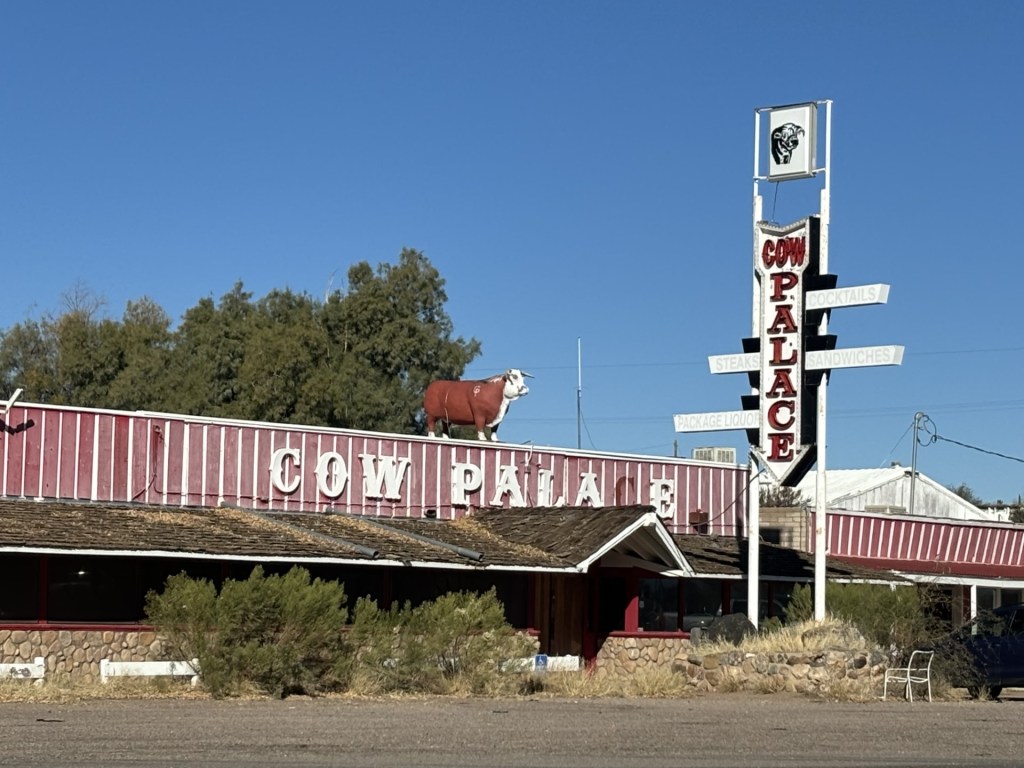
The Cow Palace, 2024
We stopped there often. My first time was after an evening of ineffectual dove hunting. Neighbors in our apartment building talked of hunting doves in the desert. I asked to go along. The hunting was a waste of time—too many hunters and the few doves were freaked out and spooked. No one took a shot. Our marriage was only a couple of months old. Mary did not realize that most hunts ended with beers. My partners introduced me to the Cow Palace. Mary shed tears of relief when I returned, having feared I had suffered a hunting accident.
My favorite Cow Palace memory occurred late one afternoon. I am dark-complected and was well-tanned because of afternoons playing pool volleyball. I had black hair and had grown a long mustache. I was delighted when returning from Nogales, a border guard took me for a Mexican and asked for my green card. I had also taken to wearing work boots I bought at my dad’s store. They were not western style, but they were heavy pull-on boots. To a tourist, I looked the part, and was even more delighted when during a stop at The Cow Palace, a traveler said to me, Hey Cowboy, I bet this place is wild on Saturday night. I had no idea, but I proudly affirmed his query as if I were a regular.
The day we left Arizona was one of the few times I’ve cried.
*Glen and Sara are pseudonyms.
 Birds and More
I think we were living in Tucson at the same time you arrived, but only for a summer. Bill had a post-doc that summer at Kitt Peak. He had an office at the university too. We lived in a long term motel with a pool in the road that led straight to the university, in walking distance. Our sons were 3 years and 4 months old. One of our biggest problems was keeping our not air conditioned car cool enough for the baby. I remember putting a towel over the steering wheel so that I could hold it. We took many long drives and hikes into the same mountains you did. We might have met!
Bill spent nights at the observatory and saw at least one spectacular thunder and lightening storm there. It was exciting. I bought some pots from the native women who worked at the gift shop. I also took a back strap native weaving class at the local museum. One little tiny rug resulted. We loved the area and returned for birding many times.
JoAnn
Sent from my iPad
JoAnn Hackos, PhD
Joann@jhackos.com
Evergreen CO
303-898-5163
LikeLiked by 1 person
Loved this walk down memory lane. It makes me wonder if you might get a second home
LikeLiked by 1 person
Too late for a place in AZ–we still have our cabin–although there’s 4ft of snow there now!
LikeLike
I remember that snow that fell during my first semester as the U of A.
LikeLiked by 1 person
Loved this one Nic. Brought to mind so many memories.
LikeLike
Thanks!
LikeLike