
He saw that this water flowed and flowed, it was constantly flowing, and yet it was always there; it was always eternally the same and yet new at every moment! Herman Hesse, Siddhartha.
What we need is a school, not another dam! complained our driver. He was lamenting the efforts of the Army Corps of Engineers. We were traveling from Big Spring to Akers in the Missouri Ozarks. My dream of a week canoeing the Current River was about to begin.
Years before, my family conceived a rare overnight excursion. My dad, owning his own small shoe store, had no vacation (See: Shoeman, How My Dad Taught Me to Be a Birder). He had two consecutive days off from work because of Labor Day. We were going to drive somewhere and spend a night in a motel. Such excitement!
Although eleven or twelve at the time, I was already devouring maps and planning itineraries. My wife shakes her head when I tell her such stories. No one else did that at your age!
The Missouri Ozarks are replete with beautiful spring-fed rivers; the most famous being the Current, the Eleven Point, and the Jacks Fork. I had read of them in newspaper and magazine articles. Though mostly within two hundred miles of my hometown, I had never seen them. I had conceived a tour of their springs. I begged my family to pursue it.
I did not know it then, but I was practicing for my adult years when I would peruse topographic maps dreaming of backpacking routes. Names of certain features would attract me. My memories of visiting those locations are a form of possession. I wanted to possess them all. In this case, it was springs.
After some resistance, my parents agreed. I have been told, usually in a positive way, that I have a talent for persuading people. In this case, being a pre-teen, more likely, I whined.
This two-day trip was a drag to my parents and especially my younger brother. I recall a lot of driving. But I also remember the curious, milky blue water of Round Spring. Here was a nearly-round hole in the ground, several yards in diameter, no current visible, only the chalky blue water. On the other side of the round hole, was the outlet from which clear water flowed into the Current River.
We visited Alley Spring on the Jacks Fork where there is a historic mill and water wheel. Best of all was Big Spring. Here, an average of nearly three hundred million gallons per day of crystalline water boils from a low rock ledge—truly river wide. Behind it, only rocks and soil. In front—a river. I was amazed. Big Spring fed the Current River, known for its clarity and wilderness qualities.
My 1970 Current River canoe trip should not have been the first. My Boy Scout troop annually paddled the river. The trip was a graduation of sorts for the older boys as they were about to transition from Boy Scouts to Explorers. I was eager for my turn. Alas, the scoutmasters for the boys a year ahead of me were active fathers who also enjoyed canoeing. The sons remained in the scout troop longer than usual and monopolized the Current River trip for three seasons rather than the usual one.
My own adult leaders probably were relieved. They were not outdoor types, using their roles as scoutmasters to escape wives and drink and play cards in their own tent when our patrol went camping. By the time the older boys moved on, I myself had “aged out” of scouting. Now, 20 years old, just before my senior year at the University of Illinois, I told my summer job supervisor I needed a week off for placement exams and schemed the river trip.
I was exhilarated when my high school friend Bill and I paddled out from the village of Akers. We had no experience with river canoeing. We did not even have life jackets. For floatation we brought rectangular boat cushions from my parent’s small boat that we used on our city reservoir.
We did not have a tent. I had brought an old shower curtain and twine, assuming I could rig a shelter if necessary. We did not bring enough food; certain we would catch fish for at least one meal. Most importantly, however, we had a case of beer. Being underage was irrelevant in our hometown, alcohol was always available to anyone who could afford it. The only thing in our defense was that we were in good physical condition and young enough to believe we were bullet-proof.
Moments into our trip, we approached the first bend, lost control, rotated the canoe 180 degrees and headed down the river backwards. At least we did not upset. We pulled over and discussed our near miss. Being young, athletic, and over-confident, we did not consider bailing on the trip. I had a book which described the river. The book advised us to aim for “downstream vees.” It also had a page on canoe strokes which we practiced on our sandbar camp that evening. The next day after two or three hours, we thought we were pros.
We had all night to contemplate what was in the book. I tried to rig a shelter. The shower curtain was too small. The available wood was too difficult to fashion into appropriate lengths and shapes. My completed “shelter” was about eighteen inches high at the four corners but sagged in the middle to a foot or less. Fortunately, the weather was not threatening so we laid our sleeping bags on the sandbar. Not being accustomed to sleeping this way, both of us recounted how the clouds had passed overhead for interminable hours. Nonetheless, the next morning we were quickly on our way and enjoying the paddling and the scenery.
We had two more frightening experiences. That first morning the river split into narrow channels, each partially blocked with sweepers. One turned us sideways against a log. I jumped out and righted the canoe just as the water was reaching the gunwale. We would have been safe, but we would have lost all our gear—nothing was tied in.
The other time we felt unsafe was days later at the confluence with the Jacks Fork River. The Current River suddenly doubled in width. There were large standing waves; the only actual rapids we encountered. We managed the waves as the pros we thought we were by keeping aimed at the downstream “vees.” Despite some bouncing and a bit of water splashing into the canoe, we made it safely.
Though it was mid-August, I do not recall seeing others on the upper river before the Jacks Fork. Now, I am told, you can practically hop from canoe to canoe without getting wet and traverse the entire river. We did not need a permit then either. We just showed up at the canoe rental.
Along our way we stopped at several springs. I had a primitive camera and still have grainy photos of our first stop, Cave Spring. Later that morning it was Pulltite Spring. These were among the first of my possessions. Now there are dozens of campsites at Pulltite.
High limestone bluffs passed in review for days. The riverside forests were lush. The water was so clear, I could push a paddle downward until my shoulder was in the water and still see the tip. We watched thousands of turtles slide into the water. I can still see a small-mouthed bass leaping from the river to catch an insect. In the bright sunlight, the flanks of the bass glowed as if made of gold.
One night we camped at Bee Bluff—a limestone cliff that loomed across the river.
What I remember most about Bee Bluff were the whip-poor-wills. They serenaded us through the night, their melodic calls echoing. It was miraculous. Did so many choose this location because of the echo? More likely the high bluff and pool and eddy below were replete with insects. It was a memorable night. Whip-poor-will populations are down 70% or more. I would love to return. How many whip-poor-wills persist, I wonder? That campsite at Bee Bluff was choice. I am certain thousands have camped there since.
With our shower curtain shelter, we were fortunate it never rained hard. During the only rain shower, Bill and I camped next to a small incline. We huddled under the canoe with the plastic curtain draped on top. Unfortunately, the campsite was on fine sand which then stuck to everything. We felt and tasted sand for the rest of the trip.
What about catching fish for one night? Although not experienced fishermen, we had all week. We would surely catch fish for that one night, wouldn’t we? Not a chance. Twice I thought I had a fish and both times it was a soft-shelled turtle. I probably killed both getting them off the hooks. I gave up.
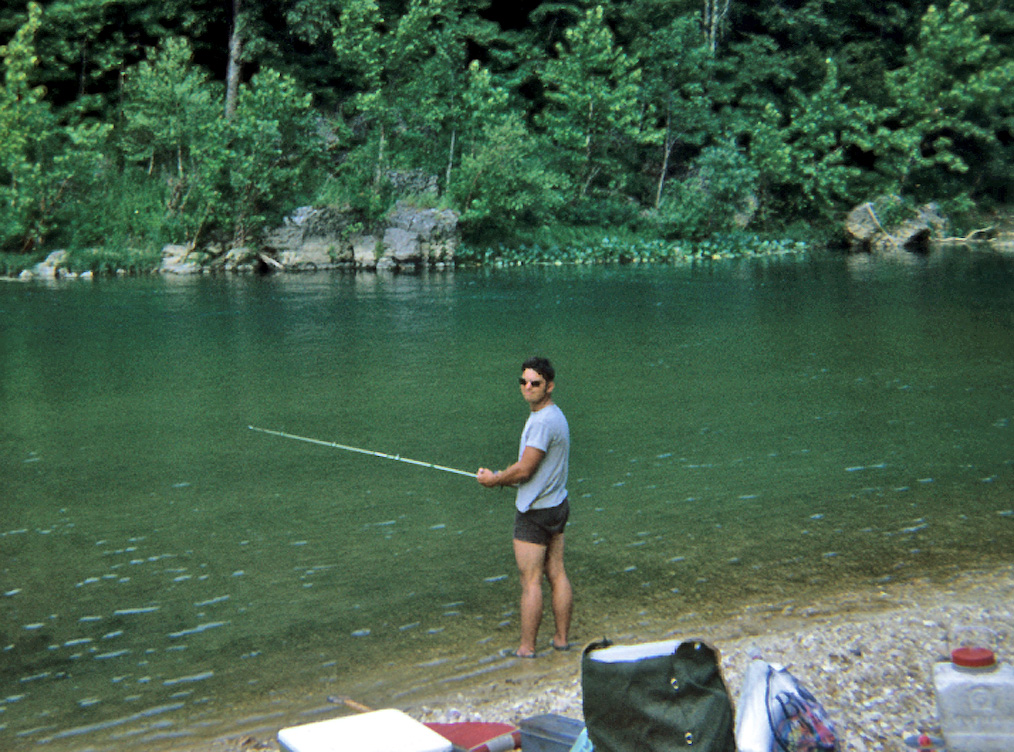
(Here I am, not catching any fish!)
While fishing, I had waded in stream side warm pools—warm because they were cut off from the flowing channel. I thought my ankles and feet felt odd. I glanced below. What are those black things? Leeches! I could not touch them. I found flat rocks and pulled them off one-by-one and waded in riverside pools no more.
It was a triumph when we pulled into the Big Spring takeout. We were safe. We felt like river pros and now we could buy something to eat after going hungry the previous night. And, what about all the beer? We did not want it. Drinking in the scenery was enough. Both of us sampled a beer once or twice. We brought the rest home with our memories.
Astonishingly, less than a year later, I was married and had moved to Southern Arizona. There, my new wife and I floated the Gila River, and once the Salt River, on inner tubes (See: Southern Arizona Magic). Those trips were party-time, group experiences, but I reveled in the scenery. Instead of forests of oak and hickory, there were cottonwoods and willows, and giant saguaros on the uplands. I loved anticipating what we would see around the next bend.
When Mary and I moved to Western Colorado, we noted the nearby famous rivers: the Colorado, the San Juan, the Yampa, and the Green. I had read accounts of their explorations by famous river men such as John Wesley Powell.
I was also captivated by descriptions of recent trips by Edward Abbey. I eagerly read everything about the now drowned Glen Canyon, especially the trips by the indomitable Katie Lee. We expected river trips to be a favorite pastime. What we soon realized, consistent with my attention to supplies for the trip on the Current River, is that we are not “gear” people.
We always preferred cross-country skiing to downhill because the equipment was simpler. River trips that involved expensive rafts, trailers, special coolers, and what appeared to be a requirement to bring a well-stocked kitchen, were daunting.
We were in our sixties when we were invited by our daughter and son-in-law to float the San Juan. The trip included another family and our granddaughter. Mary and I did not have to worry about anything but personal items. Boats, trailers, and permits were someone else’s responsibility. What could be better?
The trip timing and weather were excellent. Each morning, we were serenaded if you can call it that, by yellow-breasted chats. All day long, we watched Say’s Phoebes sail back and forth, their plaintive whistles echoing from canyon wall to canyon wall. Blue grosbeaks were also abundant, flashing navy blue.
Mostly, I enjoyed seeing the Cedar Mesa Canyons I had hiked as they passed by: John’s, Slickhorn, and Grand Gulch. By the trip’s end, low water was a problem—we had to wade and often drag the boats as we neared the takeout at Clay Hills. It was fun, but I did not envy the clean up and put-away tasks that remained for my son-in-law.
Also in my sixties, I experienced a well-provisioned, professionally guided trip on the Colorado through the Grand Canyon. I have hiked all the trails and many routes within Grand Canyon National Park, plus various routes and trails outside the park. Seeing these canyon mouths pass by, South Canyon, Nankoweap, Clear Creek, Elves’ Chasm, as the hiking memories were evoked, was thrilling. I was also able to visit canyons that were beyond my ability as a hiker and climber.
Our craft was an S-rig—more than thirty-five feet long. Riding the rapids in such a big boat was mundane. It was like riding “Logger’s Run” at Six Flags Amusement Park where being splashed is part of the thrill ride. The splashes felt great on the hot days, but there was never a feeling of risk nor the feeling of accomplishment that had accompanied my backpacking.
A week before my 69th birthday, I finally did a multi-day excursion on the Green, floating Labyrinth Canyon. I paddled a duckie with enough room for my daily gear. A good friend had a raft and carried everything else. It was fun to see the pictographs, the rock formations, and historic inscriptions. I did wonder. If I inscribed my name now, it would be an abomination. But, what about in two hundred years? Would people then search for the places I had been?
The trip was fun, although it was not enjoyable to share the river with so many other people. Camping was a problem. Many groups pulled off early to ensure an excellent campsite. One day, we could not find a camp. Every location was occupied. The upriver wind blew harder and harder. We paddled on and on. I have a nice memory, though. Unlike my initial experience on the Current River, I knew how to paddle. I was able to easily stay ahead of a couple of younger companions who were paddling the same craft as I.
It was not that my Current River muscle memory had persisted for fifty years, but that I had paddled many days and hours on a local section of the Colorado River known as Ruby-Horsethief. The put-in for Ruby-Horesthief is thirty minutes from our driveway and the Westwater takeout, only an hour and a half.
Most people take two days to float this section. We have done that ourselves. Our favorite method, again, for the simplicity, is to shuttle a car to Westwater the night before and launch on the river at dawn. In that way, the trip can be completed, sans permit, sans camping gear, even with low water, by late afternoon.
Our first two boats, before we acquired a real craft, were discount store toys best suited for large swimming pools. One had a compartment on each side and was inflated in minutes with a foot pump. I did purchase actual river paddles, the ones provided with the toys being too small and fragile.
Because of their simplicity, the discount store boats were easy to deflate/inflate and conceal. Thus, I used them to access Mee and Knowles canyons, part of the Black Ridge Wilderness Area. I assumed correctly that most people either entered the upper portions for a brief day hike or hiked up canyon from their river campsites for an hour or less. That left a lot of canyon country to explore. I floated my loaded backpack in my small boat. I deflated and concealed my small craft at the canyons’ mouths and from there embarked on multi-day backpacks before returning to the boat.
These canyons have been publicized since, but I had the experience of accessing some of the most pristine areas still available on the Colorado Plateau. Especially when I entered tributaries to the primary canyons where there were only cryptogams and faint game trails, no boot prints.
It is fair to ask, what then was I doing there? Didn’t my presence in the landscape cause the destruction I was trying to avoid? That is a justifiable point. I made allowances because of it. I was careful with routes, staying in the drainage or walking on rock slabs whenever possible. I camped in dry stream beds when certain I could trust the weather. Otherwise, I tucked my tiny tent under a juniper or piñon pine such that I was camping on a bed of needles that would show no sign anyone had been there.
I cooked on rocks in the middle of streams so that again, there would be no vestiges of my passage after the next rain. Was that enough? Well, there’s only room for one person at a time to do it this way. It is a dilemma.
Now, more people use the river and instead of there being only rental gear available, guided trips are frequent. The last time my son and I floated Ruby-Horsethief, we had pulled out on a beach to have lunch. We were conspicuous, but an outfitter had decided that beach was their lunch spot and soon more than ten canoes beached around us and more than twenty people interrupted our solitude. We loaded up and moved on.
Nonetheless, Ruby-Horsethief has provided lovely memories. One neighborhood family had splurged on a raft and gear and suggested a float with our daughters and another neighbor who had twin daughters the same age. They were thirteen. Camping that night was great fun as the young “river babes” smeared themselves with mud and splashed in the river.
Mostly what I remember, however, are nesting bald eagles, groups of chukars drinking at riverside, blue herons leisurely flapping on ahead with a squirt and a squawk. There was also the time when soloing in my inadequate boat, I was trapped in a whirlpool in Black Rocks—the one location on this stretch of river with complicated hydraulics. Around and around, I spun. I nearly abandoned the boat, but finally with a strong pull at the right time, yanked myself back into the current.
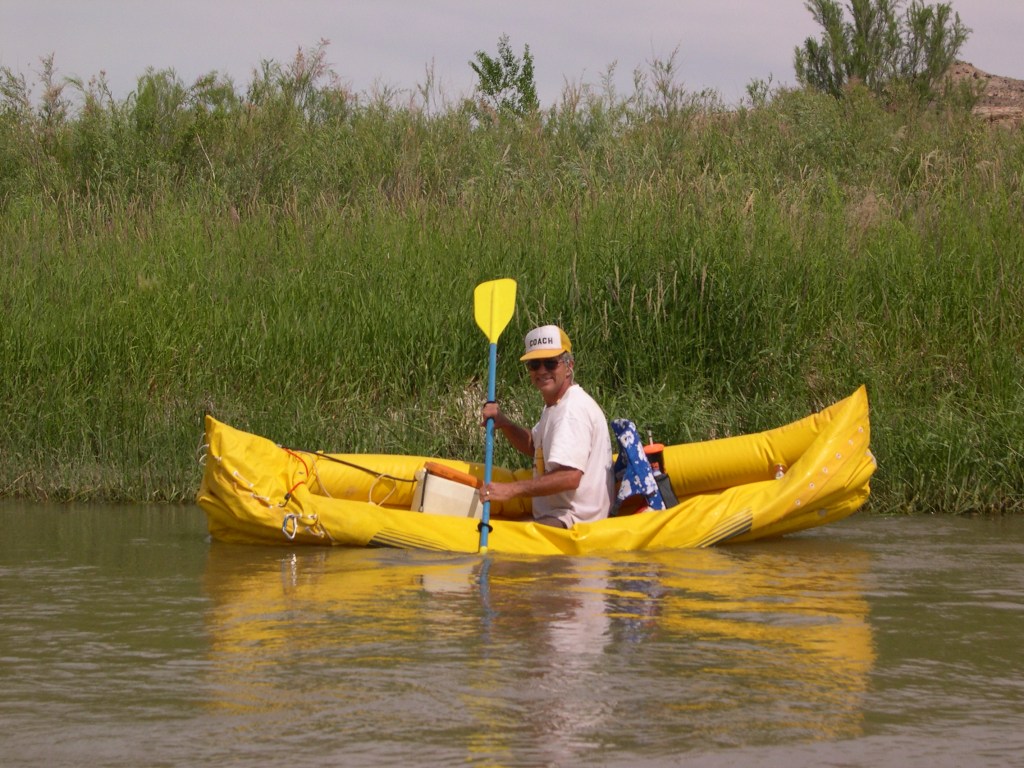
(My final voyage in a cheap boat!)
My favorite memory may be the second last float with our discount store toy. We were accustomed to seeing very few people but as use of the river changed, so did the gear. Mary and I, now in our early fifties, were floating in this cheap boat. I wore an old yellow baseball cap from my son’s t-ball days; COACH, it said, in big letters. I had poked holes in the hat and used white string to tie on sunglasses. The boat had a slow leak in one compartment so was listing to one side. We had a tiny cooler tied in; our legs draped over the side as we floated. We encountered a group of thirty-somethings—big, fancy rafts with mounted umbrellas and all the gear in the world. They did a double take when they looked at us. One shook his head, and said, I’ll say this for you guys, you’ve got style!
 Birds and More