
A New Adventure is coming up and I’m sure it will be a good one. Sigurd Olson: the final words remaining on his typewriter the day he died, at 82, while snowshoeing.
My son and I had just completed a wondrous day of skiing at Copper Mountain. Adam had driven from Ft Collins where he attended Colorado State University. I had driven from Grand Junction and had rented a room so we could have another day together. I was feeling warm and mellow, anticipating another fun time tomorrow. The phone rang.
Mary was on the line—in tears. Although low-mileage and not daily, she was a runner. Recently, she had complained of pelvic pain afterward. Today it had been intense and had not subsided.
Prior to that Copper Mountain phone call, our outdoor activities, usually backpacking, had never been curtailed by a physical problem. This time a week-long Grand Canyon backpack trip had to be cancelled. I have always marveled at Mary’s equanimity. She can find the good in bad situations and, more importantly, not let a negative condition affect other parts of her life. Nevertheless, she identified so much with her ability to enjoy the outdoors, this malady was devastating.
Now began a multiyear ordeal of orthopedic surgeons, physiatrists, and sports medicine specialists including sessions with the current and past presidents of the International Pelvic Pain Society. A pelvic specialist and then a physiatrist at the University of Colorado both proffered incorrect diagnoses. Their final recommendation was that Mary take antidepressants.
Fortunately, talented, and specially trained physical therapists identified asymmetries in Mary’s body caused by a displaced tailbone from a previously forgotten childhood accident and by post-appendectomy surgical adhesions. The asymmetries were addressed with frequent manipulation and exercise. Although Mary was able to backpack again, her disorder requires vigilance and occasional treatment. Regular physical therapy visits are a lifelong routine. We had to plan shorter trips, limit the weight she carries, and be more careful about terrain.
As Mary improved to where she could manage longer walks, Adam and his wife-to-be, asked if Mary could do a trip to Minnesota’s Boundary waters. The planned trip had mostly short portages. Adam said he could carry Mary’s gear so she wouldn’t have to handle any weight.
The trip was an ideal corrective—a backpacking-type experience with minimal stress to Mary’s condition. Her gear fit easily into Adam’s large pack, so she had no sense of being a burden. Adam and I had to make two trips at each portage anyway—one with a canoe, one with packs. Mary could be just as busy around camp as ever.
There was a further reason the trip had special significance. Sigurd Olson, one of the founders of The Wilderness Society, had long been a favorite writer. I had already read most of his books describing the Quetico/Superior area. Olson worshiped wilderness. His books are replete with extravagant descriptions of his feelings about the landscape. I once lent one to a well-read friend and when she returned it, her comment was a quizzical, Don’t you find his writing pretentious? Put on the defensive, I made an excuse, but as I thought of it later, I decided Olson’s unabashed and, yes, conceited love for the area resonated with me.
Here’s an example: I have discovered I am not alone in my listening, that almost everyone is listening for something, that the search for places where the singing may be heard goes on everywhere. It is part of the hunger all of us have for a time when we were closer to nature than we are today. Should we actually hear the singing wilderness, cities and their confusion become places of quiet, speed and turmoil are slowed to the pace of the seasons, and tensions are replaced by calm.
Furthermore, Olson had kindled my interest in the voyageurs, the area’s original canoe travelers, who had transported supplies and furs from the 1680s until the late 1870s. At their pinnacle in the early 1800s, the voyageurs numbered up to three thousand. The deprivations and labor these men endured, and the wilderness they experienced were awesome to contemplate.
Having no previous experience, an excursion that far northeast of our home in Western Colorado had never been considered. Fortunately, Adam and Cara had a contact who worked for an outfitter; they arranged everything. After our long layoff, Mary and I were delighted at the prospect of a new and unexpected wilderness adventure.
My fantasies and dreams about the region were fulfilled. I was exhilarated by the idea of portaging, even though once, I rammed the canoe into a tree, knocked it off the shoulder pads and briefly stunned myself as it bounced on my head. Our travails, of course, were nothing compared to the original voyageurs who carried at least two ninety-pound bundles of furs. I was able to fantasize about walking in their footsteps on routes that had been used for centuries. At one turn, I almost rammed my canoe into a moose. Its height was startling. It was the first I had ever seen.
Our campsites were regularly serenaded with loon music as one or more pairs danced and called in the twilight. I had read of it, listened to recordings, but to hear the eerie wailing at a wilderness campsite, what could be better!

Dueting loons.
I had read of loons and North Country fishing in Outdoor Life and Sports Afield. Those magazines were my teenage escape from Southern Illinois where fishing was limited to whatever lived in the nearby muddy creeks and ponds–usually catfish and bluegill. Catching smallmouths in Minnesota evoked those wistful dreams of my youth when the idea of such sport had the same reality as trapping Martians.
Additionally, I caught them with my trusty Zebco 33 reel, bought when I was twelve. Here, 45 years later, I was using the same reel on a trip that would not be happening without my son and his girlfriend. I wrote in my journal: —What would that twelve-year old have thought to envision being on a lake like this with my son, his girlfriend, and a wife of 35 years that I deeply love? I would have been thrilled, I’m sure.
At home, a week later, I added: I do wonder what it means exactly, now sitting here thinking of my own aches and pains, and Mary’s. I was taught, or learned, that if I were good enough life would be pain free. Not so. I have learned that the older one gets, the more physical pain is involved and the more you know to worry about. On the other hand, while on this trip, I celebrated my wife, caught smallmouth bass, heard loons calling, watched eagles soar, and heard Cara giggling as she and Adam talked. The beautiful things were all I observed. Why weren’t my problems relevant then? Because they are minor? Because I couldn’t do anything about them? I wonder. In my mind’s eye I return to paddling on a wilderness lake as the sun sets. Very near to us, loons laugh and call and hoot loudly.
Our camps were idyllic, except for mosquito time, regular at dusk, but untroublesome otherwise. Once, we camped on a peninsula so narrow, it felt like an island. Birdlife was impressively absent, except for the calling loons. The other sound was red squirrels chattering incessantly. One evening, I wrote: The sunset was magnificent—a red orb dropping through high clouds and finally disappearing within the dense forest before leaving us in darkness.
I appreciated that campsites were established. The remaining landscape was choked with deadfalls and brush or was impassable bog. Often our paddling was through narrow passages fully engulfed in grasses and pond lilies. The tall birches and filmy fern-like balsams were lovely.
Once when exiting the canoe onto what I thought was solid ground, I plunged in thigh deep. At another portage access, a woman who had arrived before us, pointed our way to safety, saying the most obvious step was booby deep, as she had just plunged into her chest.
On our toughest day, the weather threatened with thunder and occasional gusts of wind. We had to paddle across a large lake. Landing for the portage, in contrast to the usual boggy landings, we encountered a narrow, stony, trail. This portage was narrow, steep, rocky, and uneven, not soft, and smooth as we had become accustomed. Although we had done a portage two and one-half times as long the previous day, this one was more difficult.
Later, I learned this portage crossed the Laurentian Divide, the remnant of the former mountains. Glaciation had left the area with only a thin layer of soil. All around us were the Precambrian igneous and high-grade metamorphic rocks that form the ancient geologic core of North America. We were experiencing the Canadian Shield the deep bedrock that stretches north from the Great Lakes to the Arctic Ocean, covering over half of Canada and most of Greenland while also extending principally into parts of Minnesota and Michigan in the United States. As we continued paddling, we passed a series of lakes: but there were no campsites, only twenty-to-thirty-foot cliffs of Precambrian Canadian Shield. Though confined, I mused that these inaccessible lakesides must be true, deep, wilderness. The water itself was a clear, bottomless green.
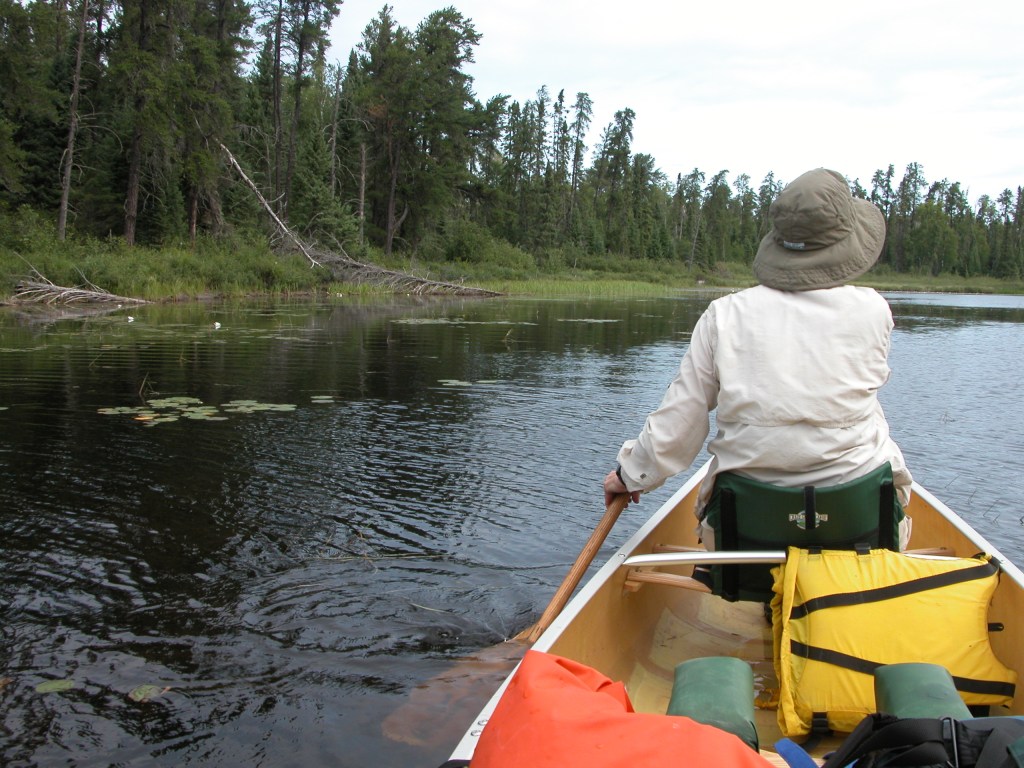
Mary propelling our canoe!
As we paddled from one lake to the next, the weather deteriorated. The sky was black. Fortunately, there were only a few gusts of wind as we quickly learned how defenseless we were in our lightweight canoes.
Bolts of lightning flashed in front of us. We paddled half of the lake before taking a campsite on a long finger that stretched toward the middle. We ate lunch under a tarp to shield us from the rain.
When the rain ceased, I had a chance to explore. Even on a peninsula, I recognized how easy it would have been to become lost on land. There were no landmarks and no obvious lines of travel. But then, I confronted something remarkable. Here was an enormous field of ripe, red raspberries. Was it an acre? More? I could gorge on them.
I did not even pull out my fishing gear. I ate raspberries. I finally understood how a bear could survive on berries. Indeed, I kept looking for one. Surely the size and status of this extravaganza had to be familiar to local bruins.
I ate and ate and wondered where the bear was. It was a fantasy. The sun finally came out. Mary and I swam in the surprisingly warm water. Later, on a rock partially out in the lake, I read more of Olson’s Open Horizons. He quoted Kalil Gibran about a friend who had died: For life and death are one even as the river and sea are one and what is it to die but to stand naked in the wind and to melt into the sun and drink from the river of silence. I wrote: I like that. It would be good at my own funeral.
About 5:30 the next morning after a stormy night, there was a roar of wind. Our canoes were beached but I heard them shuffling about. I was about to emerge but heard Adam out already to ensure they did not blow into the lake. Later that morning, we saw canoes that had suffered such a fate. Groups were standing at their campsites, somberly viewing their submerged canoes, well out in the lake.
Our float that day was difficult; very narrow. We had to step out into the water and pull the canoes over beaver dams. We paddled into bogs where we wondered if we had lost our way. But we found the portages we expected. I saw my one new bird on the trip– a black-backed woodpecker.
The trip was the perfect antidote for our previous year of inactivity. Although older than anyone else we encountered, we now knew we could still do things. Our outdoor activities, while changed, were not over. It was gratifying when we approached a portage where a group of men, mid-way between our late-50s and Adam and Cara’s mid-twenties had to wait briefly for us to land our canoes. They had a great deal of gear, possibly having been out for weeks. One of them looked at Mary and I and said admiringly, Well, here are some young folks wanting to have fun.
 Birds and More