
Yes Yes
I see it
so they won’t keep telling you
where it is
Lying While Birding by Naomi Shihab Nye
I’m often asked, “What is your favorite bird?” I admit to preferring some more than others, but an ultimate is asking too much. Ask me for memorable birding experiences, well, that is different. Here are a few. *
*My book TEN JUNGLE DAYS, describes favorite sightings of Lanceolated Monklet, Black-Crowned Antpitta, Thicket Antpitta, and LeConte’s Thrasher. A previous blog, “The Most Difficult Bird,” is about my experiences seeing a Rosy Thrush-Tanager.
COCKATOO
I was sitting at my tiny first grade desk. The final bell rang. I emerged from the basement of what is now the St Paul Parish Center, ran up the steps, raced down Lemon Street, turned right on 9th, and yelled into “Tony” Lang’s basement for him to hand me the day’s newspaper.
I slowed as I grabbed the paper. There was a pink, crested bird in the tree above me. It looked like the cockatoo in the World Book Encyclopedias my parents had just acquired for me. Excitedly, I finished running 9th, dashed across Poplar to our small home at 709, and told my mother what I had seen. She laughed. I was embarrassed when she related the story to others. I had seen a female Northern Cardinal. It is fitting that my initial field identification was a mistake. It was not the last.
It is surprising how much I learned from our little yard in Illinois. I loved to climb the Chinese Elm in the backyard, brush off the ubiquitous little worms, and gaze toward larger trees down by the “branch,” a small drainage that connected to a nearby creek. I watched Common Grackles and Mourning Doves perch in the dead limbs.
Once, I found rows of neatly drilled holes in that Chinese Elm and was thrilled when a Yellow-bellied Sapsucker, not expecting a boy in the tree, came to visit them. Our face-to-face encounter was unforgettable for both of us.
A baby bird was under that same tree another day. I caught it and put it in the cage we had bought for my recently expired Budgerigar. I hung the cage in the tree with the door open and watched. A Baltimore Oriole! It fed the youngster once, then coaxed it from the cage into the tree and away.
I was also enthralled by our neighbor’s Purple Martin house. I enjoyed watching the acrobatic Martins swoop through the sky. Watching them taught me to despise House Sparrows and European Starlings because both would battle the martins for nest holes.
The best yard sighting was when I yelled to mom, “there’s a Brown Creeper in the front yard.” Perhaps, remembering my mistaken report of Australian avifauna, she was not interested. I begged her to look. She was shocked at first, then impressed. I was on my way!
BLACK-FACED SOLITAIRE
The Resplendent Quetzal was revered by the Aztecs, is the face of money in Guatemala, and easier to see in Costa Rica than any other country. It was highlighted in brochures we had studied before our first trip in 1989. At that time, the Monteverde Cloud Forest, because of the Quetzal and the now-extinct Golden Toad, was Costa Rica’s most famous eco-tourist destination.
We arrived in the early afternoon needing to leave twenty-four hours later. We had made what was then the long drive to Monteverde after a marvelous party the previous evening at our friend Raquel’s home (See: Don Tino’s Strange Fruit).
These days, renting a car in Costa Rica is as easy as anywhere but that was not the case in the 1980s. Raquel’s family advised that rental agencies near the airport were unreliable and expensive, so she drove us to Central San Jose. The car we thought we had reserved was not “ready.” We refused to accept the car that was offered because we needed a 4-wheel drive. After an hour’s wait, they rolled out a dented, well-used, dark-green, diesel-powered, 4×4.
Raquel led us out of the city, or we would surely have gotten lost. Once underway, the road, was narrow, curvy, and slow, but seeing signs directing us to Panama or Nicaragua was exhilarating. We watched for the turnoff to Monteverde having been instructed to find a bar, just past a small river.
We stopped at the bar and asked, just to be sure we were on the right road, but we received more than directions. The bartender pointed at a man sitting outside and in broken English, told us he needed a ride to Santa Elena, which was on our way. Everyone was friendly and our erstwhile rider looked at us so imploringly that we consented. I could scarcely believe it. We had been in the country less than 24 hours, and we had a hitchhiker, something we would never have done in the US. Our rider spoke no English but smiled benignly as he climbed in the back seat with Ann and Adam.
As we left the pavement and started up the rough road I hit a deep pothole. The back door of the battered vehicle sprung loose, popped up, and our luggage bounced into the road. Fortunately, the suitcases did not burst open, only suffering dents and scratches. We re-loaded and continued.
The road was steep and sinuous, only a single lane wide alongside steep drop offs. At the first of these, our rider gesticulated excitedly and tugged at his unlocked seat belt. After a bit of mutual consternation and more pantomimes, we understood he wanted us to unfasten our seat belts because if we ran off the road, we could more easily jump out of the car as it tumbled down the mountainside. Fortunately, we had no mishaps and delivered the man to his destination.
Today, Monteverde is replete with hotels, zip lines, restaurants, yoga retreats and so on. The road is wide and paved. In 1989, there was one small, hotel and a couple of smaller lodgings known as “pensions.” The “restaurant” where we dined that first night was under a carport. We suspected they merely made four extra portions, and the family enjoyed the same meal.
Before checking into our room, we drove to the reserve entrance and asked about guiding. We were here to see a Quetzal and had no idea whether we would ever return to Central America. We arranged to meet a guide, Alan, early the next morning. He said he had arrived on New Year’s Day and had seen a Quetzal every day since. It was now mid-April. We retired that night with confidence.
The next morning, we awoke to a shock. We arrived on a sunny, calm, day and woke up to fog, rain, and high winds. The consequence was that we learned when such days are bad enough, Quetzals move downslope to escape the weather. Alan tried to convince me that seeing a Black Guan (not a big deal) and a Red-headed Barbet (sort of a big deal) were adequate compensation, but they were not. We had to make the long drive back to the Central Valley bereft of a Quetzal sighting.
That drive was wild. It was market day. The road was crowded with slowly moving, mostly beat-up trucks full of produce. We learned that horn honking was not about warning of danger but communication such as “yes, I should not have passed but I am coming on anyway. Stop and let me in.” Large trucks were not always able to slow down fast enough; their return honks meant, “Stop, and go back or you’ll be in a head-on!” If there had been a crash, it would have been a demolition derby.
Repeatedly, on curvy, uphill sections where my vision was obscured, a truck driver would wave for me to pass. Sometimes that worked but often enough the wave morphed into frantic gestures that I should slow and get back to avoid an oncoming vehicle.
For miles we were trapped behind a truck laden with sugar cane. Fragments of the load rained on us as we followed. Safely back at Raquel’s house I asked about the reckless driving. She laughed and said Costa Ricans thought they had a sixth sense when it came to cars and traffic. I read later, at that time, Costa Rica had the highest per capita accident rate in the world.
We had survived our initial excursion into Costa Rica’s hinterlands and into a cloud forest. We live in the desert where the land is dry, and the colors are browns and reds. What had I expected when I encountered cloud forest for the first time? A forest of clouds or a forest in clouds—a forest fashioned by clouds. It is all of those, but what I perceived was that our luck was bad.
Birding was practically impossible. Gusty winds swirled cloudy mist through the treetops and, at times, to ground level. I would aim my binoculars toward a moving object a few meters away and whether leaf or bird, it would quickly be obscured by fog and occasional sheets of rain. My binoculars fogged so badly they were barely functional.
The forest soared into the foggy mist. The largest cottonwoods along the Colorado river would be part of the understory. These giant trees were of the genus Quercus. If that sounds familiar, it is because they are oaks but even grander than the great old oaks I knew growing up in the Midwest.
“Festooned” is a cliché but no word better describes the massive branches, each supporting a plethora of vines and bromeliads. Only the stoutest limbs can sustain so much wet vegetation. These limbs can sustain tons of vines, epiphytes, and bromeliads. Everything I touched felt like a wet sponge. Moisture dripped from above. Fog swirled horizontally. All this, I realized, is cloud forest. This is how it is.
Alan identified a few calls amidst the roaring wind— “an Ochraceous Wren,” he said. I finally had a fog-obscured glimpse. And then, I heard an odd, soon to become familiar, sound. The usual description is of a swinging, rusty metal gate. “That’s a Black-faced Solitaire,” said Alan. I looked up. “You won’t see it,” he continued.
He was right. The sound emanated with the dripping moisture amidst the swirling fog from high in those oaks. When I trained my binoculars upward to search for the sound I was rewarded with water droplets on the lenses.
Other sources refer to the call of a Black-faced Solitaire as flutey and ethereal or complex and exquisitely modulated. That’s better. The call evokes a solemnity and power that is the essence of its environment. It is a sound that evokes dripping green and riotous growth. Aldo Leopold referred to the “numenon,” that entity without which a particular biome cannot exist. His examples were the Ruffed Grouse in the North Woods and the Pinyon Jay in the high deserts where I live (See: The Numenon: Pinoñero Nostalgia). Likewise, a Costa Rican cloud forest does not exist without Black-faced Solitaires. Their songs support the famed ornithologist Alexander Skutch who called the tropical rainforest “the greatest example of nature’s creative process.” I did not see a Black-faced Solitaire on that day, but their essence had invaded my soul.
Happily, there are periods of sunshine and calm in the cloud forest and Black-faced Solitaires can be spotted in flight and followed to their lofty perches. When not breeding they can be found in loose flocks at lower elevations. Thus, often enough, I have been able to enjoy the steely blue-gray color of their bodies and the black face, both offset by the bright orange of the bill and legs.
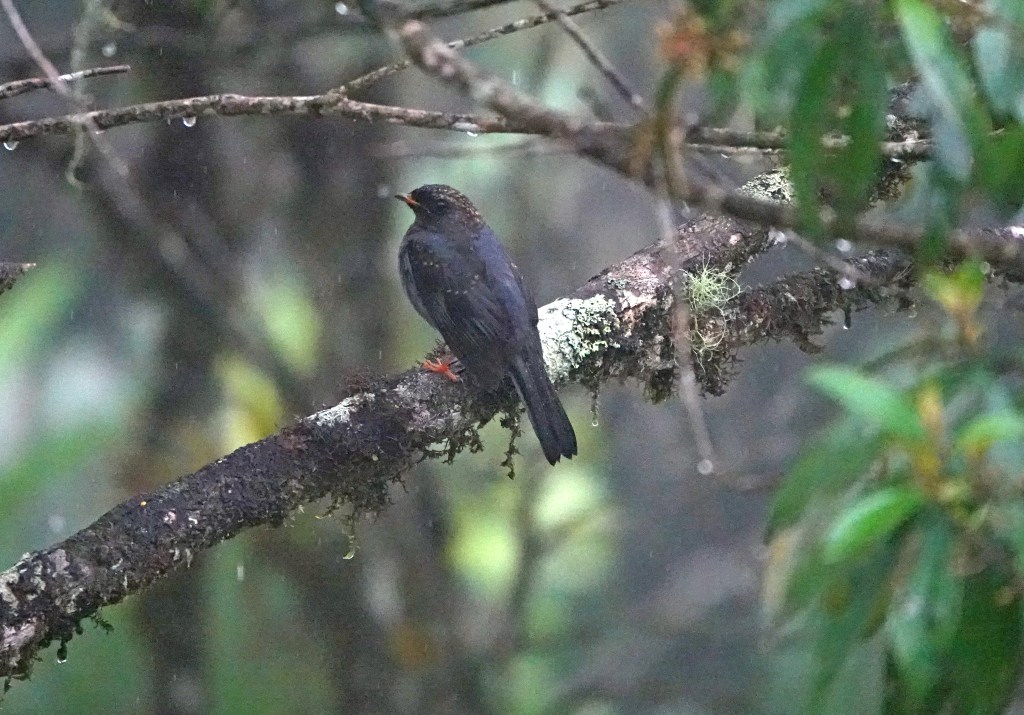
(Black-faced Solitaire, juvenile)
My most memorable view, one-hundred miles to the southeast, thirty years later, was so unexpected, I could not identify the bird for several minutes. I began my hike just after five because the sun rises early near the equator. The slight mist that was falling became a steady, rain. I opened my small umbrella—essential in this environment. I moved slowly hoping for ground-dwelling species because the conditions made viewing of even the mid canopy impossible.
It was November, out of the breeding season for most species. The forest had been silent except for one or two exuberant outbursts from a Gray-Breasted Wood-Wren. After an hour and a half, I had detected only three species but was feeling satisfied with a close encounter I had just had with a Zeledon’s Antbird.
I love antbirds for their need for pristine habitat as well as there being no analogs in temperate climates. I had observed a beautiful male—black except for the pale blue skin around his eyes. I watched him swish his tail slowly—a prominent characteristic— as he disappeared in the understory.
Suddenly, I heard an unfamiliar call.” An upward slurred nasal ghank,” I wrote in my notebook when my Merlin bird app did not recognize it. The call was rising from the ground. I perceived movement. I approached cautiously trying to obtain a decent view in the gloom. Though partially screened by vegetation, a dark plumaged bird was walking back and forth on a small horizontal branch, all the while repeatedly uttering ghank, ghank.
It was a typical rain forest dilemma. How to sneak close enough without frightening the bird? I eased forward. My quarry was stocky, mostly gray. Too large and plump for most of the tanagers, I thought of grosbeaks but a partial view of the head indicated not that family. I saw a flash of the bill…orange. The feet were orange too. Now I saw it fully. It could not be, but it was — a Black-faced Solitaire, two meters away and on the ground. I watched it for a long time, back-and-forth on the branch, ghank, ghank. It appeared to be a display, but on the ground? For what? Months outside of nesting season? Where was a potential mate? What about that strange call? I have checked subsequently. Monographs on the bird do not mention such behavior. Birding guides I have queried had never seen or heard of it either. For me, it was a lovely bird, the numenon of the Cloud Forest, gifting me a special moment. **
**The Xeno-Canto wildlife sounds data base has examples of this call.
RESPLENDENT QUETZAL
Fortunately, our time with Raquel and her family had gone so well that we eagerly returned two years after our failed attempt to see a Quetzal. Once again, we headed for Monteverde and arrived at the reserve early in the afternoon. I asked at the entrance if there had been Quetzal sightings. The gatekeeper knew of one that morning and gave me the name of the trail. We went hiking. I am still disappointed Mary, Ann and Adam did not remain. Birding is too slow for them and the gift shop at the reserve entrance beckoned. By myself, I continued for a while further. No luck.
I turned back but remained vigilant. I scanned the forest for the tall dead trunks Quetzals use for nesting. They are obligate cavity nesters and despite their small, weak, and stubby bills, excavate the cavities themselves. Consequently, Quetzals as with the rest of the trogon family, mostly nest in rotten trunks. Indeed, a frequent cause of nest failure is when a too-rotten trunk collapses before the chicks are fledged.
I spied such a trunk and a cavity. Protruding from the hole were two long, green, plumes. The plumes were ragged from being bent to fit inside the cavity into which the bird had disappeared. Then the male peeked out and began expelling the contents of the nest hole as it worked. I was ecstatic. I knelt to be unobtrusive, but what it was, was reverence. It was me and the Quetzal. I had waited two years to return wondering if I would ever see one. There it was. I knelt in adoration for many minutes. Eventually, it flew to a nearby branch to preen in the sunlight.
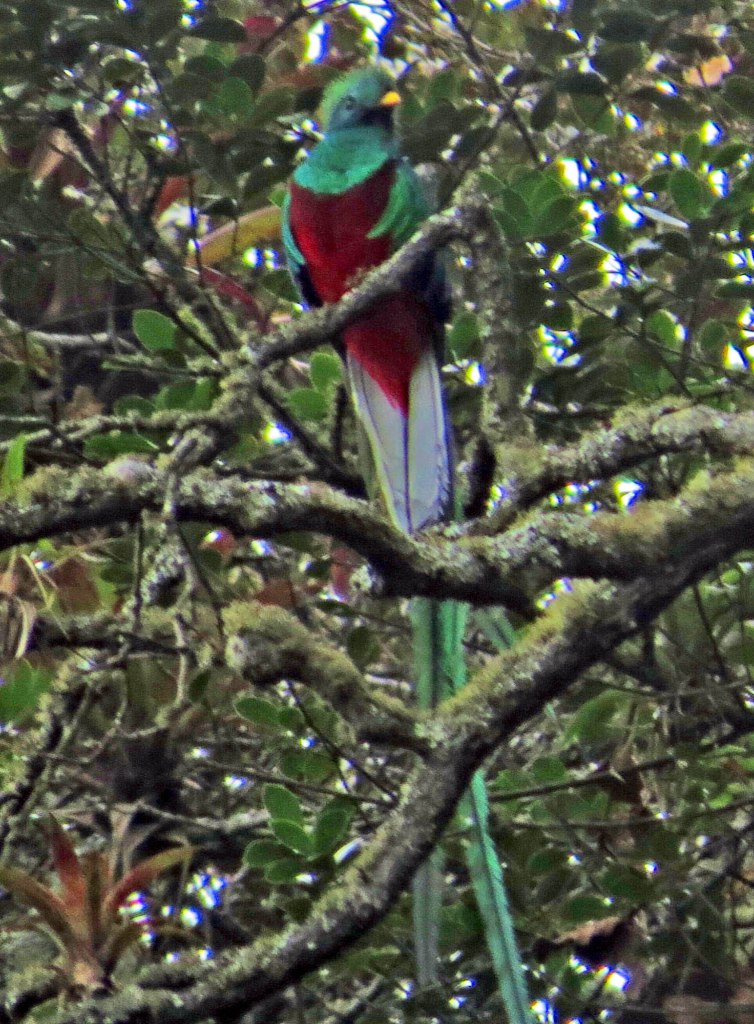
(Resplendent Quetzal)
Photos cannot prepare one for the bird’s size and stunning colors. The brilliant red breast, the emerald-green body, the golden-green crest, the ebony shoulders and the snow white undertail are magnificent. I was not prepared for the greens shading to blue when displayed clearly in the sunlight. And the thirty-inch plumes! I consulted the online database Birds of the World. There are many bird species with names containing superb, beautiful, and elegant. Fittingly, only one species is Resplendent.
BLUE WINGED TEAL
Does it seem strange that a common North American duck with a population in the millions resides next to Resplendent Quetzal as a memorable sighting? The reason is the Tody Motmot. Of Costa Rica’s six motmots, I was missing only the Tody. Lesson’s and Turquoise-Browed Motmots are splashy and common. The Rufous, Broad-billed, and Keel-billed may not be as easy, but can be found without inordinate effort, but not the Tody. The latter is smaller, shier, thinly distributed, and lacks the flashy racquet-shaped central feathers characteristic of the others. Mary and I had already organized and led a group trip to Costa Rica as a fundraiser for Grand Valley Audubon. Accordingly, when we planned a second trip, I selected Heliconias Lodge as one of our stopovers. I had been watching birding trip reports, and this was the most reliable Costa Rican location to find a Tody.
We did find a Tody Motmot on the last hour of our last day, but my most memorable sight when we stayed at Heliconias was of Blue-Winged Teal. It was 2011, more than twenty years since our first trip to Costa Rica’s Caribbean slope. The roads were better and there was much more development, but one thing had not changed: the vagaries of the weather. Both days we planned for birding Heliconias were beset by high winds, heavy rain, and fog. Our guides talked it over. We bailed for the coast. Because of the vastly improved roads, it only took an hour or so to reach the lowlands.
Our guide Ernesto asked our van driver to stop at a private school. He collected a little money from each of us and entered. He returned with permission to access land behind the school, a former catfish farm.
The habitat consisted of dry fields interspersed with ponds. We had a fine time identifying grassland birds and in one large pond, a variety of ducks. Most were Blue-Winged Teal, but the special prizes were Northern Shoveler and Cinnamon Teal, rare birds in Costa Rica and much sought after by Ernesto and our van driver for their country lists. Our group had our own views of the common ducks easy for us to see at home while we searched for wrens and seedeaters in the fields. We saw other interesting birds for Costa Rica, such as a flock of Dickcissels and the introduced Tricolored Munia.
This was Guanacaste, a region known for a pronounced dry season. It was remarkable how near we were to the wet and misty cloud forest. Yet here the fields were reminiscent of autumn in Western Colorado–mostly brown, little green. As the day waned, I found myself separated from the group and thought I should return. The setting sun at my back cast everything with a golden hue.
I noticed an area we had not checked and moved in that direction. Part of me regrets what happened next, but I had no way of knowing what a disturbance I was about to cause nor what beauty I would see.
I ascended a small rise which turned into a dam behind which was a tiny pond 30 by 50-meters. Tucked in the corner of the property, distant from the larger ponds, perhaps this one was usually less disturbed. Our group had been walking all about. Many ducks had flushed. It seemed every Blue-Winged Teal we had flushed congregated here. As I peeked over the rise, I was five meters from a pond so full of ducks the water was not visible. It was bank-to-bank and bill-to-rump with Blue-Winged Teal.
They rose as one with a stirring whir of a thousand wings. Their takeoff was not random, but in one large formation, side-by-side. Their bodies were golden in the setting sun and their wing patches a dazzling azure. Apart from a blue sky, I had never seen so much natural blue at one time. It was breath-taking. Later that night, others spoke of Streak-backed Orioles and Red-legged Honeycreepers. I spoke of teal!
SANTA MARTA PARAKEETS
It was the third day of our Colombia trip…the first morning at the famous ProAves, Eldorado birding lodge. Our small group, myself and friends Larry, Coen, Brenda, Tom, Kay, and Linda, loaded into two beat-up 4×4 vehicles. It was 4AM. We had to ascend a rough road to be on the San Lorenzo ridge by daylight. Our wish was that three or four critically endangered Santa Marta parakeets would fly over the ridge at dawn. We were hoping someone would spot them coming and we would have time to detect color in their mostly green bodies: orange and red underwing coverts, blue primaries, and reddish-tinged bellies.
Being so near the equator, sunrise is akin to a curtain rising. We arrived and abruptly, it was full light. Almost as suddenly, there were parakeets. Not three or four, but everywhere. They landed so close; the excited drivers began snapping away with their cell phones. There were dozens of parakeets. They squabbled and hopped from branch-to-branch as they interacted. Some interactions were copulations. Some were fights. We forgot about the cold coffee and rice and beans we were handed for breakfast. That stuff was warm at 3:30. It was a nasty repast now, but the birds were enthralling.
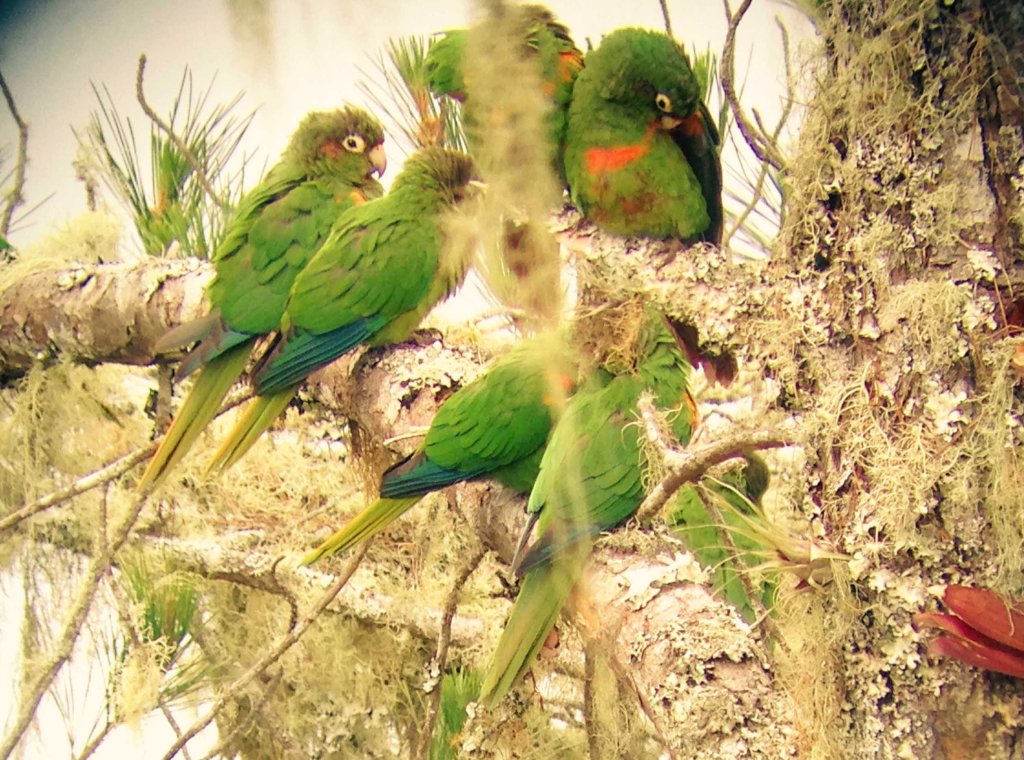
(Santa Marta Parakeets)
This was a perfect beginning to one of my most amazing days birding. Shortly afterward we viewed a Santa Marta Bush-Tyrant, a Santa Marta Brushfinch and a Santa Marta Warbler. Notice the theme. This isolated mountain range in Northern Colombia may have the highest rate of endemism in the world. The Journal Science, called the area “the most irreplaceable site on earth” of all protected areas worldwide. We were convinced.
The excitement of our guide and drivers at the parakeets informed us of our luck. Subsequently, I read that the entire population in this area, believed to be 60 to 120, represents about ten percent of what remain, and that they are only rarely encountered in groups as large as 20. We counted more than sixty with some within three or four meters. They paid little attention to us. We were so engrossed that I can no longer remember how long we were entertained. And then, they rose as one and were gone.
ROSY-FINCHES
“I wish I’d been there!” was the reviewer’s response. You see, I had turned in an ebird list with 1050 rosy-finches, including Gray-crowned, Black, and Brown-capped. My list also contained thirty Common Redpolls. It was New Year’s Day 2013. My friend Larry was assisting me count birds in my area for the Grand Mesa Christmas Bird Count and we had turned in an improbable account of our birding that morning.
This area is usually nearly sterile on New Year’s Day. We can drive for miles and see a few Common Ravens and if we are lucky, maybe a Bald Eagle, maybe a Red-tailed Hawk. This year, the year of the pink cloud, was different.
Few birds in the Western Hemisphere exhibit pink in their feathers. Some Pine Grosbeaks appear pink as do some Crossbills, particularly the White-winged variety, but nothing rivals a swirling flock of Gray-crowned, Black, and Brown-capped Rosy-Finches. Plumages are variable because of sex, subspecies, and age, but every flock exhibits bright pink.
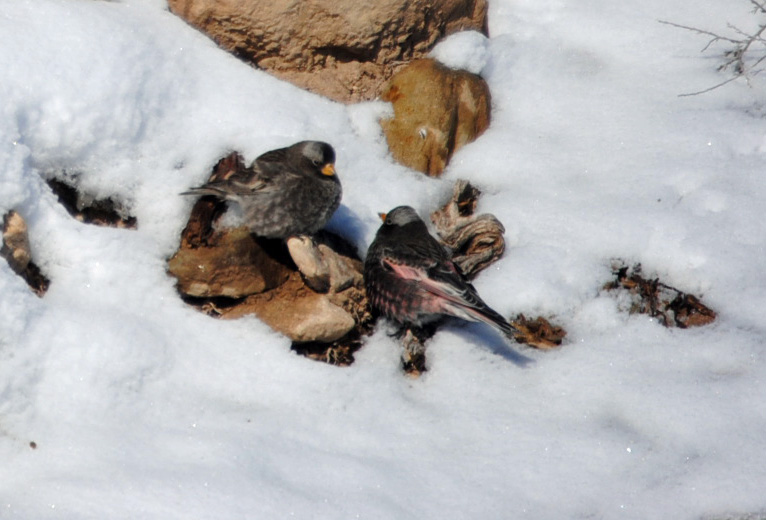
(Black Rosy-Finches)
Even without the pink, let’s say it is a dreary day with flat light, a flock of rosy-finches can be recognized by the way the flock darts and settles and repeats frenetic movements. Rosy-Finches are adept at sudden changes in direction, sudden landings, and sudden takeoffs. If the day is bright and the sun orientation is appropriate, their pink flashes are a treat.
Rosy-finches are not easy to see, surviving as they do in cold steep places. The population of the Brown-capped Rosy-Finch, a near endemic to Colorado (a few live in Wyoming and New Mexico) was believed to be in trouble until a recent study, described as “walking slowly and looking for birds on 45-degree rock slopes, on unstable footing and crumbling rock,” estimated the population to be a healthy 115,000 to 150,000; three times what was estimated in 2016. The study found rosy-finches prefer cliffs and snow patches between 11,500 and 13,200 feet. Unless the weather is not just bad, but really bad, they can stay up there all winter. Gray-crowned mostly nest in British Columbia and Alaska and Black Rosies nest in the high mountains of the Northern Rockies in the US. When they wander during the winter, they often find each other such that flocks may contain all three species. The best time to find them in our valley is after a series of storms in the high country. The finches are irruptive and gregarious. I had seen them several times, but in flocks of tens, never hundreds.
We encountered at least a thousand feeding along the roadside. It had been cold and snowy, and the birds had descended to feed on seedy plants. We were supposed to check a much larger area, but instead, we stayed with the finches and drove back and forth on the muddy road. Our excuse was to count the rarer Redpolls that intermingled with the Rosy-Finches. The large flock rolled with our passage. We would stop and so would they. They fed just outside the vehicle windows, almost close enough to touch. When there were junipers, some would perch, giving the impression of a Christmas Tree.
When we moved, so would they. It was thrilling to mingle in the rolling pink cloud. I doubt I will ever see anything like that again.
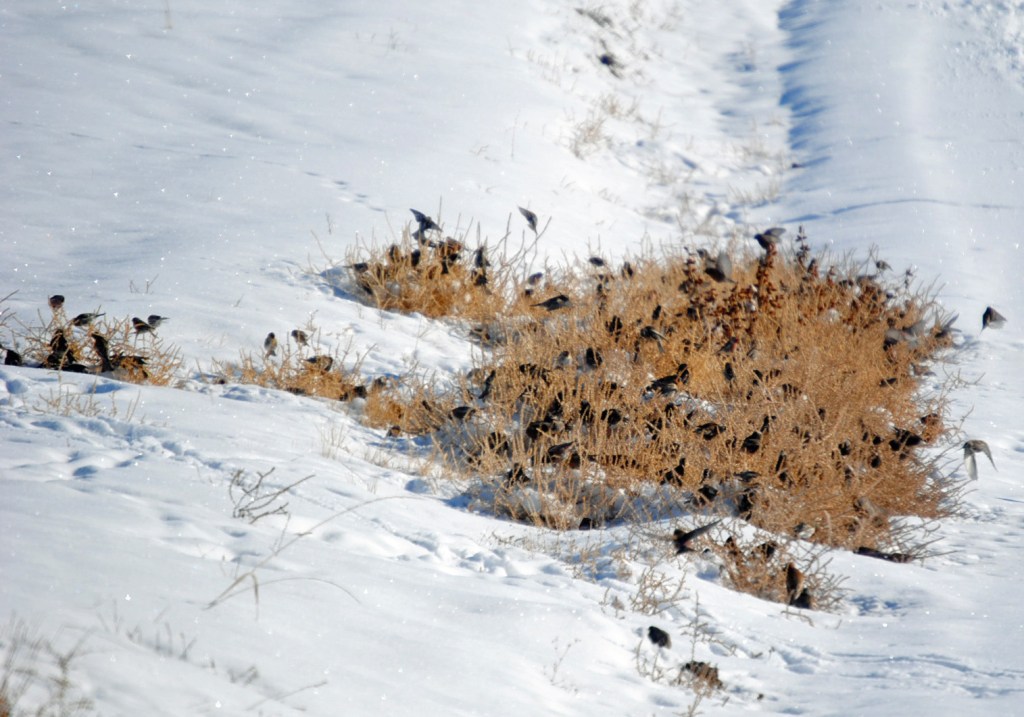
(A fraction of the Rosy-Finches we saw!)
My ebird checklist had flagged my counts for all three rosy-finches and the Redpolls. The reviewer was required to check. I sent back not just photos but a verbal description of what we had witnessed. No wonder, he responded as he did.
BLACK-THROATED HUET-HUET
“You never know where your kids are going to take you,” lamented my mother. She was referring to Mary and my move to Tucson for graduate school. Before that trip, she had been no further than 250 miles from her childhood home of Highland, Illinois. She was so uncomfortable visiting that she brought jugs of water for drinking.
In our case, our daughter did not take us to another state, but to another country, Chile. Unlike my mother, we were serious travelers having already been to Mexico and Central America. We were delighted to visit. Still, Chile had not been on our radar and if Ann had not taken a job there, we might never have visited.
Our goals were to see Ann and whatever she wanted to show us. It was not a birding trip. Nonetheless, Ann, true to her upbringing, wanted us to see some National Parks and climb La Campana, a small peak famous both for its view of the towering Aconcagua (the largest mountain in the hemisphere) and for having been summitted by Charles Darwin.
Studying what birds I might see proved difficult because I had never heard of them. What was a cinclodes? A tit-tyrant? Or a canastero? Finches I had heard of, but their variety and similarity were confounding. Nevertheless, I had some exciting views: flocks of Hudsonian Godwits, dozens of Black-faced Ibis roosting on our hotel’s rooftop in Castro on the island of Chiloe, and Slender-billed Parakeets lighting up the bare limbs of a dead tree. The most memorable, however, was a Black-throated Huet-huet.
My overall failure seeing the species with exotic names may have had something to do with my fondness for the Huet-huet. My luck had been poor with dotterels, rayoditos, and miners. I may have been desperate for a close encounter with one of the bird families previously unknown to me.
Huet-huets, of which there are three species in their genus, are tapaculos. It was the first of that family I had ever seen and is also the largest. Confined to Southern Chile and adjacent Argentina, they are ground-dwellers, known for digging up invertebrates from leaf litter.
It was mid-morning of our visit to Puyehue National Park. We were on a walk and had seen nothing more than the common flycatchers and finches. We sat for a rest. Nearby was a dense, shrubby, thicket, three-to-four meters in height. I decided to investigate. It was possible to lift some outer branches and crawl inside. Hunched over, I moved about until I heard a loud scritch-scritch. Close! Almost at my feet was a chubby, large-eyed, chestnut brown bird with a rufous belly and cap. I observed the powerful thighs. The feet and legs were incongruously muscular on a bird that size. “Drumsticks! I thought. Perfect for a bird that scratches and digs. The big shoulder revolved as the bird rotated its powerful legs and large feet through the leaf litter. I had found a Black-throated Huet-huet.
Then I was drawn to the large eye, peering directly at mine. Usually, if a bird and I are eye-to-eye, the moment is fleeting, and the frightened bird departs. This time, I sensed cognition and discernment. “I see you. You are not a threat, but I am not taking my eye off you either.” Less than a meter from me, the bird simultaneously watched me and scratched in the litter. I knew that birds, with their eyes on either side of their head could use them independently. The Huet-huet was demonstrating—one eye concerned with its safety, the other with dinner. Occasionally it grabbed a morsel, but even though the head jerked to feed, the eye never wavered from mine. For several minutes it scratched, dug, and fed at my feet. Moving slowly as it hunted, the Huet-huet scratched its way into thicker brush and out of sight. I was grateful. Through that eye, the bird had drawn me into its world. For a brief period, I knew what it was like to be a Huet-huet.
 Birds and More