
In the silence and the heat and the glare we gazed upon a seared wasteland a sinister and savage desolation. And found it infinitely fascinating. …In the morning we went on, deeper into the back country, back of beyond.
The Indians were here first. They discovered America, explored it and settled it, and in so doing did not overlook even the most obscure canyons of the southwest. SLICKROCK, Edward Abbey, 1971.
I told myself the new landscape was as good, but it was not. The flowering was not as profuse nor as colorful as the Sonoran Desert. The plants were not exotic; nothing like saguaros or ocotillos or the various chollas. Where were the Gila Monsters and Desert Iguanas? It was the same with the birds. Where were the bright colors of a Vermillion Flycatcher, the weird guttural nhuh nhuh of a Cactus Wren?
I expected to like the Redrock Country. I had read DESERT SOLITAIRE and Edward Abbey’s pronouncement that Utah’s Canyon country was the most beautiful place on earth, but I also knew when I read the book, Abbey himself lived in or near Tucson. It was a while before I appreciated the Redrock forms for their singular beauty.
Now, I have lived in the Redrock country for more than forty-five years, consecutive except for one in Missouri where I would tell my children that the sky was not blue. Blue was a cloudless western sky contrasting with a Redrock canyon wall.
In Missouri, I missed the odor of sage. I would crush the leaves with my fingers and inhale the fragrance during every hike after we returned to Grand Junction. Although I missed the rainy-season scent of Sonoran Desert creosote bushes, the sage had become as precious. The Redrock had become home.
I had the good fortune of local fieldwork assignments, spending dozens of work nights in Eastern Utah in Monticello and a few more in Moab, all related to investigating contamination remaining after uranium mining and milling. In the 1980’s, tourism was a fraction of now. Both Moab and especially Monticello retained a small Mormon town ambience. One local health officer, an occasional co-worker, told me he was moving back to Idaho. I asked why, and he said, I have been a Mormon all my life, but even after three years, I’m not accepted here. You have to be born here!
With the ever-present, dazzling skyline of the Abajo and La Sal Mountains, it was a magnificent area in which to work, except for dinners. Monticello had a single location where a beer could be purchased with a meal. An elderly woman had converted her garage into a steakhouse. I hesitate to call it a restaurant. She would shuffle to the table and say: Ribeyes is ten. Sirloins is eleven. T-bones is twelve.
I ate there enough to learn that all steaks went on the grill at the same time and came off when the thinnest was well-done. Always. It did not matter what was requested. Those of us with more experience would take advantage of new companions by telling them how bad the steaks were. Inevitably, they would order the cheaper, thinner, ribeyes such that the thicker T-bones we ordered would come off the grill before being overcooked.
Our initial intimate experiences in the Redrock country were at Arches National Park. Mary and I visited the first weekend after moving to Grand Junction and it was a favorite place when our children were young. This was before the advent of campsite reservations. We would leave home before seven AM so we could arrive about nine and hang out in the full campground like vultures, waiting to descend when someone left. We had a favorite campsite which we secured several times. We could put our tent up a small hill within a group of boulders. We had privacy and it was perfect for keeping track of children.
One night a storm of dangerous winds, rain and sleet battered the campground. We had put Ann and Adam to bed. Mary and I, not wanting to disturb them, tried huddling in the lee of a boulder. We watched as campers around us packed and left—including some with truck-mounts or with trailers. We could understand after we tried sitting in the car. After twenty minutes of rocking and buffeting, we decided to pack up and drive home. Surely, Ann and Adam were disturbed by the heaving and loud whacking of the tent, but both were sleeping soundly. What to do? We gave up and crawled in. I remember moving my sleeping bag as far from the tent walls as I could to keep them from flapping against me. I hoped no poles would snap and bring the tent down on top of us.
We heard more people pack up. Our kids slept on. I do not recall whether I fell asleep before the wind ceased, but I remember waking to a practically empty campground on a still and sunny, albeit cold, morning. Mary was nestled deep inside her sleeping bag, still slumbering, as were the kids. Our bags, despite the tent being zipped, were covered with a layer of red sand.
Our “stay” was rewarded. We had a near-private experience with the Fiery Furnace’s exquisite arches, towers, and narrows. Reservations had been required and it had been full, but now it was only us and another couple.
That is not to say that we never aborted a camping trip. Ann had just turned two. Adam had gestated approximately eight months. We were camping at Split Mountain Gorge in Dinosaur National Park. I have a vivid memory of vultures preparing to roost alongside the Green River. They sailed back and forth as the sun set behind me. The vultures’ shadows were projected on the canyon wall opposite. Shadows and vultures were black and weaving up and down, back, and forth, closer, and farther. I never expected vultures to be so enchanting.
But then the rain came. We retreated to our tent, then decided we would be more comfortable reading to Ann in the car. After the rain stopped, we lifted Ann back into the tent and turned to gather more gear. We heard our daughter giggling as she jumped around splashing in water. We had two inches in the tent. We packed it all up and drove back over Baxter Pass for an after-midnight arrival at home, but with pleasant memories all the same.
Our most beloved tent camping site was at Capital Reef National Park. In the mid-eighties, the Park was never crowded, even at midsummer when campers could indulge, as did the resident deer, on heavily laden apricot trees in the historic orchards. Our campsite was next to the Fremont River. I would sit in the shallow, swift river with only my head exposed; my lap full of heavy rocks so I could remain stationary. Violet-green Swallows and White-throated Swifts would zip by inches from my face.
While in camp, we were lulled by the sound of the river as Mary and I conversed at the picnic table. Our children slept well, as they always did, not pacified by the murmur of flowing water but by the promise of donuts. All they had to do was not get up once we put them down for the night. We chuckled as we would often hear one or the other hiss at their partner. Be quiet!
Our sojourn in Missouri caused us to miss Capitol Reef for a few years. In the meantime, the Park Service expanded and redesigned the campground. The charming tent sites by the river were eliminated. An area was designated for tents as if by afterthought. It was in the middle of a turnaround where all the traffic had to pass. I wrote to the superintendent, complaining about our disagreeable experience. His response was unsympathetic, saying we should buy our own RV.
Three decades later we finally visited Zion National Park. We hiked/waded the famous Narrows. We rode the first bus in the morning and while usually in sight of others, had a pleasurable experience—one-way. On the way back, we encountered the multitude. When we emerged from The Narrows to the concrete path that returned us to the bus stop, the approaching throng made it impossible to walk normally or stay on the sidewalk. Similarly, climbing Angel’s Tower was exhilarating. The vista outward was expansive, but up close, my view was the belt of the person in front of me, as if we were riding a crowded escalator.
I now compare such places to museums. For example, in Florence, we went to the Galleria dell ‘Accademia to see Michelangelo’s David. I thought I was prepared, but I was amazed by the statue’s perfection. As expected, I shared the encounter with an elbow-to-elbow crowd. I am not saying the experiences are bad, only to describe how they are. I would not change it if I could. Our National Parks need to be available to everyone, but we need other locales set aside, where numbers are controlled, where wildlife and solitude are paramount.
As our children became of age, and with the masses assembling at the National Parks, we switched from car-camping to backpacking. Early spring was our favorite time. The mountains were still snowbound. There were no leaves, no insects, and few birds, but we were ahead of crowds of people and gnats.
Our first camp was near Bullet Canyon’s Perfect Kiva and Jailhouse Ruin on Cedar Mesa. Although the trail was well-trodden, the surrounding area was unspoiled. We had a spacious site to ourselves, a grand view, and enjoyed the full moon’s descent behind the canyon’s walls. In the morning, we were treated to a young Peregrine Falcon squawking for food from the cliffs overhead.
That first trip was memorable for the wide-eyed excitement of our early-teen children as they spotted ruins. Despite the thick brush, which my son referred to as running the gauntlet, they would throw off their packs and scramble the rough paths up to an alcove. Sometimes there was only a granary. Sometimes it was more. A year later, we avoided Kane Gulch and Bullet Canyon, where we often had been in sight or hearing of other people. We saw no one except near the Collins Trailhead. At Water Canyon, we viewed the interesting panel of pictographs and the Red Man, a well-known figure, legs shown crossed as if striding along. Instead of a calling Peregrine, we were regaled by eerie screeches from juvenile Great Horned Owls.
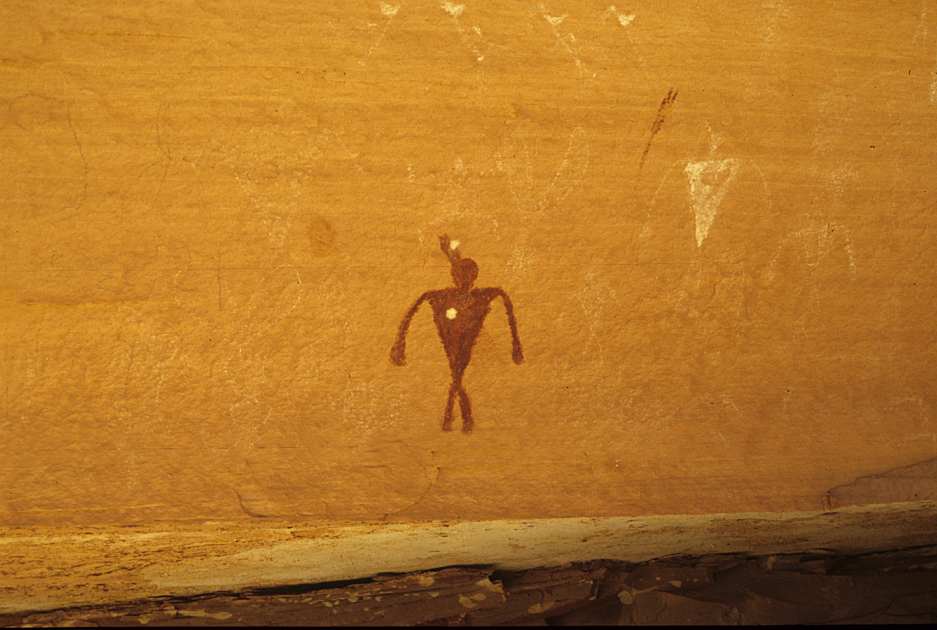
The Red Man, Water Canyon.
From a ranger’s tip, we entered an unnamed side canyon. Entry was not difficult although there was a ledge where we had to remove and hoist our packs before scrambling up ourselves. The ranger called it Shangri-la. We could see why. The canyon was unsullied. No trail, no human footprints. Never had I seen darker cryptogams. We were careful to stay on game trails as we hiked. We felt bad for being there and wondered why the ranger had told us about it. (He must have told others. While drafting this essay, I needed less than a minute on the internet to find references to hiking within this canyon. Shangri-la no more!)
Not wanting to spoil the ambience for others by leaving obvious signs someone had camped, we pitched out tents in a dry section of the wash near a clear pool. We had supper, cleaned up, and watched the setting sun illuminate spires on the canyon rim as if they were medieval towers.
It was cold, but a superb night for stargazing. Wasn’t this a pastime of the Ancestral Puebloans? There is Rigel and there is Betelgeuse. What were Puebloan names for those stars? Our canteens were frozen in the morning but warmed quickly in the rising sun; accompanied by the ubiquitous “mew” of Spotted Towhees—the sound of spring on Cedar Mesa.
That night, back in Grand Gulch, we camped near Grand Arch. Rock chips were abundant. Corn cobs remained, as did small animal skeletons. The alcove was adorned with three types of ancient handprints: flat and normal, spiraled with white fingers, and green ones. We held our own fingers above those ancestral hands and contemplated the passage of time and humanity.
A waist high ledge comprised a natural kitchen counter within the arch’s alcove. Well-worn depressions indicated its use as a metate. We stood there ourselves and rolled and pushed an elliptical stone, a mano. We discussed those who came before, eight hundred years ago, and thought of them grinding corn, standing where we were, listening to the ancestors of the towhees mewing softly in the brush. What name did the Ancestral Puebloans give them? Did they name them after their call, or their loud habit of scratching fallen plant detritus?
I realized this location was one of the few places on earth where more people lived hundreds of years ago as compared to now. How long had they lived here? Did they grow corn just there? What happened to them? To where did they move?
I noticed a tamarisk. It was not there when the Indigenous were here. What will our house be like in a thousand years? Will there be a trace of us? Will anyone ponder those who came before? Before our house was built, the property was a sugar beet farm and desert before that. Here, I suspect the Puebloans would be chagrined at how the stream has incised and how erosion has taken their corn fields.
A subsequent trip found us in Slickhorn, a different sort of canyon than Grand Gulch. Mary did not like it because passage was more akin to scrambling than hiking. I celebrated the fact that Adam, for the first time, was carrying the most weight. (Ann was now away at college.) Our first lunch stop was graced by a bighorn ram chiseled in the rock above.
We found a fine camp on our third day. Mary, having tired of loose rocks, was content to stay and read. Adam and I decided to hike to the San Juan River.
Hiking from a desert rim, down a drainage and finally emerging at a mighty river is something I have experienced often. It is a spiritual experience. Those canyons are usually dry and hot. The idea of a river feels incongruous. Eventually, you know you are close. Is the river around the next bend? No! Maybe the next? When you arrive, it is shocking to see all that water in the desert.
The approach to the San Juan from Slickhorn is notable for the pour points. Ten, twenty, thirty feet below is a plunge pool of aquamarine water. You find the bypass, reach the bed, inspect the pool, consider how deep it is, then turn back downstream and hike to the next one. I wished it were warm enough to swim, but if it were summer, there would be no water, or it would be stagnant. At the time, after reading Abbey, Ann Zwinger, and others, reaching the San Juan in this way was the fulfillment of a fantasy. I told Adam I felt conflicted about my exhilaration, Here I am almost fifty. This is something I have long desired to do, but I am also realizing I will not do everything I wanted.
Adam and I returned to Cedar Mesa on a hot, June weekend to explore Fish and Owl canyons. We saw ruins immediately in Owl Canyon but noted how dry it was. How much wetter was the climate when ancestral Puebloans inhabited the area?
After a while, we approached a pool. From above, Adam guessed forty feet deep. I thought ten or more. It would have been an amazing swimming hole, but it was a quarter mile past the pool before we reached creek bottom. It was one hundred degrees. We did not feel like hiking back.
We watched the intermittent pools dwindle as we hiked on. Our guidebook said there was water at Nevill’s arch—but we walked a half-mile past as it became drier and drier. We had to backtrack to Nevill’s and a half-mile more to find a tiny pool to camp alongside. We spent the evening watching the bats sailing up and down the canyon while we discussed our books. I was re-reading Gabriel García Márquez One Hundred Years of Solitude and Adam was reading Nabokov’s Pale Fire. MY SON!
The next day, we found it so dry at the confluence, we wondered if we would have water that night, but upper Fish is spring-fed. Black Phoebes were feeding young. Common Poor-wills called into the night. As one would expect, this area was well-known to the Ancestral Puebloans as ruins were all about. It was also where I barely missed what could have been a serious accident.
We had found an acceptable campsite and set up our tents and spread out our gear. I decided to explore further upstream. Minutes away was the perfect campsite—better watered, better shaded, and with a more expansive view. I returned to Adam. We must move, I said. He was reluctant, but I prevailed. Not wanting to repack, I slung my pack over one arm, having to hold that arm behind my head to support the weight. I locked my other arm around my still put-together tent and entwined various other gear in my fingers. As we were making our way, I tripped on a slight downward slope and fell face first into a trailside tangle of stout brush. Adam, frightened, came running. He helped extricate my gear so I could get up. My forehead and one cheek were scratched. I looked again at where I had fallen. Three or four inches in either direction and I could have impaled an eye or pierced a cheek. I felt stupid—and lucky.
On later trips, we hiked John’s and then Main canyon. In the latter, I picked up an ammo box that had been set there for hikers to record comments. My son, who was amidst earning his bachelor’s degree in English, had arrived several minutes earlier. Maybe he had a recent creative writing class. He had written, we didn’t see any of the elves. Perhaps the Mormons ate them.
I made subsequent trips to Grand Gulch with friends instead of family. The trips were shorter, but we explored more of the side canyons, visited the Green Mask, and viewed other rock art. It was interesting to contrast this civilization with the Mayans and with Europe at that time. What circumstances of climate, arrival time and culture kept this society so far behind? Or was it behind? Perhaps, we cannot read all the signs! I also thought about what the inhabitants in 1200 CE wondered about those 500 years before.
As time passed, crowds in the Redrock became more problematic, although sometimes we had good luck. When we backpacked the Paria, there was a flash flood warning. The rain never occurred but we learned later that the warning caused two, large risk-averse commercial trips, that had the same permitted itinerary as ours, to cancel. We had the Paria almost to ourselves.
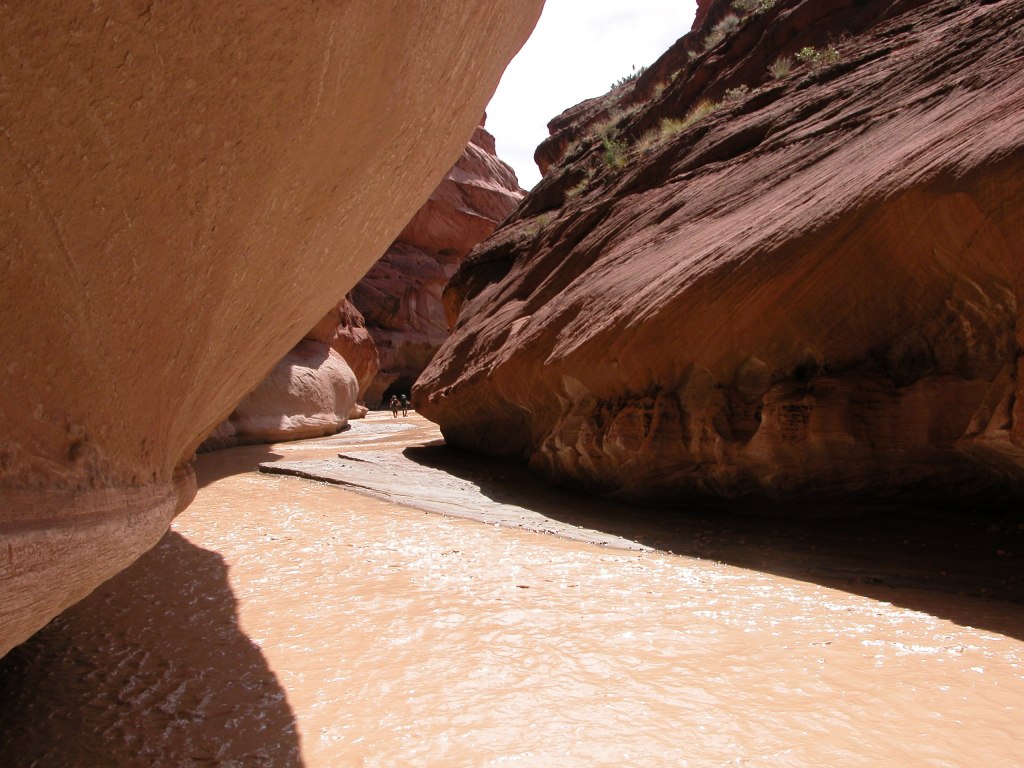
Hiking the Paria.
In contrast, a friend and I planned a trip from the Hole-In-the-Rock Road. We hiked Coyote Gulch first, following it to the Escalante River. The Bureau of Land Management required permits, but there were no limits. It was a pleasant hike, but groups were camped at every bend. What good then, were permits?
We had planned to descend the slot canyons Peek-a-boo and Spooky, but the parking area had the appearance of Black Friday at the mall, so we opted to hike down Fence Canyon to visit Neon Canyon and the so-called Golden Cathedral, a pour point with a remarkable triple arch.
With a nearby early morning start, we had a private experience with the Golden Cathedral. From there we hiked into Choprock canyon—which had an exhilarating section of narrows and again, saw no one. But that changed on the hike out. Hikers headed to the Golden Cathedral were spread over the countryside. One couple intersected the trail. We queried them. There had been a “post” on a certain website. Someone had informed the world that 1.3 miles could be saved by avoiding the trails. Everyone was marching across the landscape as they followed the post’s GPS waypoints. I have complained about our National Parks being overrun. At least in the Parks, efforts are made to confine people to trails and educate them why it is necessary—not so much when the BLM manages the areas.
One of my last backpacks into Utah’s canyon country was the Woodenshoe-Peavine route into Dark Canyon. Unlike the Cedar Mesa hikes, this one is at a higher elevation, exceeding 8000 ft at times. Our guidebook called it the wildest canyon in Utah.
The route was usually straightforward but there was a swampy wet meadow for a mile or so where the trail frequently disappeared. We had to walk back and forth to find it. On the other side was a perfect camp under large ponderosa pines. I thought I was in the mountains of Southern Arizona. During the night I heard Flammulated Owls, Common Poor-wills, and coyotes. Unfortunately, we paid a high price for the campsite because we had not traveled far enough. The next day we had to hike ten hours on a mostly dry and dusty trail.
Mercifully, our lunch spot was splendid, at a lovely hanging wall spring upstream of the Woodenshoe/Dark Canyon confluence. The spring flowed fifty-sixty ft down a canyon wall creating a lush green, hanging, garden although only droplets splashed into the pool below.
In the middle of that hot afternoon, however, farthest from the trailheads, I took notice. There was no sign of cattle grazing! The cryptogams were dark and faultless. I did not see cheat grass. Imagine that! Increasingly weary, we bemoaned our guidebook which falsely promised water at Trail Canyon. Eventually, we found a stagnant and silt-laden pool for our night’s water.
The final morning’s hike was a microcosm of western public lands’ issues. The drainage, Peavine canyon, became well-watered, lush, and green. Birdsong was everywhere. We encountered elk, including three handsome 6-point bulls. Then we reached a fence. Cattle were on the other side. The final part of the hike was denuded, incised, and smelled like a stockyard. I was horrified that “my” public land was so ill-treated. Grazing public lands accounts for a tiny fraction of the beef industry and this was one of the worse examples I have seen of range abuse. Being in a National Monument, as now exists for the Grand-Staircase Escalante and the Bears Ears, is insufficient protection.
Ten years later, our daughter, nostalgic about her childhood memories, asked us to accompany her family to Grand Gulch. Being in our seventies, me with recent back surgery, a multi-day backpack was not appealing. But we wanted to go. They were exiting Bullet Canyon where we had camped the first night on our first backpacking trip into Cedar Mesa. I proposed that Mary and I hike into Bullet and meet them on their fourth night. We would arrive late in the afternoon and then explore together in the morning and hike part way out, spending one more night on the trail before exiting the following morning.
It was exciting to backpack with our grandchildren. Mary and I reveled in the realization that our example was extending to the next generation. We had a delightful time, but the landscape was hammered, showing signs of the hordes that had passed by in the intervening years. Instead of a single path, trails of use crisscrossed everywhere, many of them eroded waist deep. The land was mostly stripped of vegetation. Anywhere someone could camp, had been overused. There were other groups camping within earshot. At least there was no trash.
Ed Abbey imagined a conversation between a Utah Mormon rancher and an angel. The angel had come to tell the rancher to go more easily on the land, that there were too many people. The rancher replies, We got to be fruitful! The angel responds, Not like fruit flies! Not like maggots! I am afraid we have done so.
In his book SLICKROCK, Abbey has a section entitled How It Was. He bemoans the impossibility of recreating the experiences he remembered before the road was paved south of Blanding, before there was a bridge over the Dirty Devil, et cetera, et cetera. He would scoff at the experiences I treasure but now grieve as no longer possible, as being deficient compared to how it was for him. But both of us are asking the wrong questions, lamenting the wrong circumstances. Abbey and my how it was, would be meaningless to the Ancestral Puebloans. Everything is impermanent. Everything is changing.
 Birds and More