LILLY

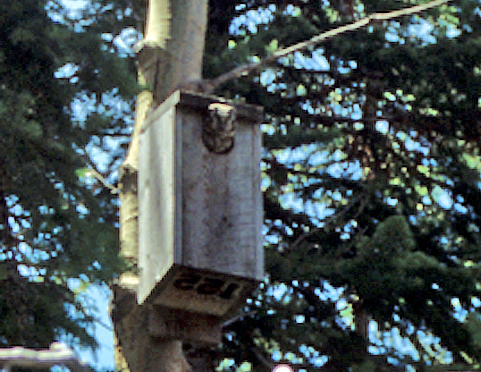
I arrived at the same time as the mail.  Instant recognition.  Michelle, the mail-carrier, and I were old friends.  We exchanged greetings and I said something about delivering the mail on a hot and windy day. “It’s a good job,” she said, “because I get to meet people like these,” as she nodded toward the yard I was entering.  I was there to look in the owl boxes on the property.

I opened the gate in the chain link fence to the large backyard or was it a small farm?  On one side was the iris collection.  There was a multiplicity of colors and heights.  Many, I was to learn, were rare and valuable.  I walked a bit further and found the vegetables, the berries, the grapes, the fruit and nut trees. Lilly and Mick gave me big smiles and were happy to tell me about their recent visitor: A Western Screech-Owl.  They had been throwing hamburger on the roof of their shed, hoping that would persuade the owl to stay.  I doubted that would work, but I enjoyed their delight in having the owl in one of their boxes. 

I have a camera-on-a-pole that I use to check nest boxes for the owl project Grand Valley Audubon has in the Grand Junction area.  Typically, I turn it on as I’m walking to the box, insert it, give the receiver a quick look, turn around, turn off the camera, get back in the car and leave—takes about 3 minutes, but never at Lilly and Mick’s. 

I have a lot of boxes to check.  I’m usually in a hurry. I usually don’t check boxes on evenings or weekends because too many conversations, pleasant as they are, obstruct my time schedule.

This place was different.  “When are they likely to be home and in the yard?” I would ask myself.  I loved to learn about what they were growing. Their interest in the owl project was boundless.  Typically, they would insist I take something home. One time it was a bag full of filberts. I didn’t even know they grew here.  If it were fall, it would be some iris splits—some of which still grow in our yard.  They also had a collection of cacti and succulents.  Lilly was upset when the City did a redesign of the street in front of their house.  The work left an unsightly barren area.  The City said she could make a garden of it as long as she took care of it.  She filled it with desert plants.  Sometimes I found her out there working on them.  The City even graced the area with a sign.
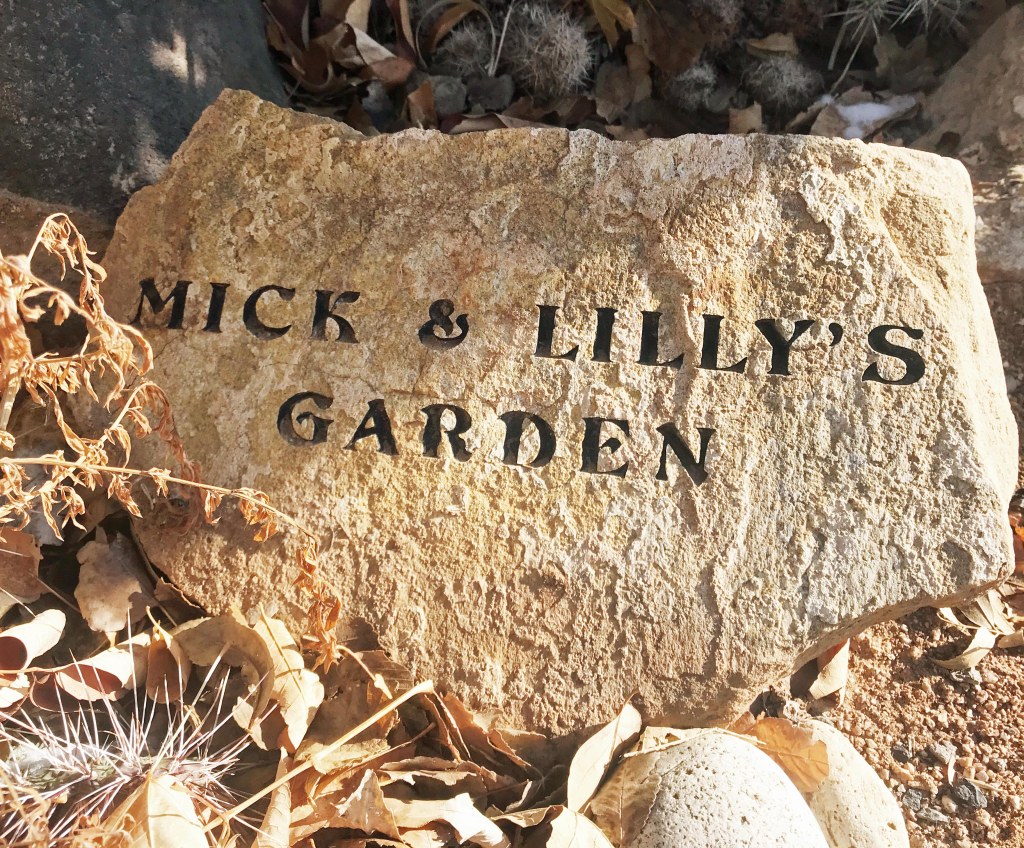
Sadly, Mick died in 2007 so most of my encounters have been solo with Lilly.  She was a pioneer daughter—the first non-Indian family to live and ranch in NW Colorado, she told me.  Mostly she was simply friendly and happy to discuss owls and ask about my family.  

I used the owl project as an excuse to visit several times a year.  I would decide one of her boxes needed to be repaired or moved giving me an excuse to stop by.  Coming by for iris splits in the fall was another excuse. 

Lilly would always run out excitedly to find out if she had an owl.  She was so thrilled when I could show her one.  I was more disappointed than she was when there was no owl because I didn’t get to experience her excitement.  If I could have trapped one and relocated it on her property, I would have done so.  Her health and energy declined.  The last time I showed her an owl, she had been ailing and I had to hold and focus the binoculars because she didn’t feel able to walk back to the occupied box. 

As the years went by, she told me a few stories of her pioneer upbringing.  She told me her job as a small child was to protect the chicken feed from the sage grouse.  She said, “Nic, those sage chickens, that’s what we called them, would darken the sky.”  I responded. “Lilly, no one is ever going to see that again.”  (The Greater Sage Grouse population declined approximately 97% during her lifetime.)

Another time she related how as a child; she went out to raid magpie nests because the county had set a bounty on their eggs. She was so small, she needed help to get on the horse, but was glad it was gentle enough to remain under the trees she had to climb to retrieve the eggs.  The only problem was she forgot to bring any sort of container. She used her pockets. When she returned home scratched and bloody from climbing the messy trees favored by magpies, all the eggs were broken.  She cried. “My mom felt sorry for me,” she said, “and gave me some money anyway.”

She always declined offers of help, saying she had a relative, a nephew, I believe, or else she had hired some help.  She and Mick had no children.  Over time the plantings flagged, and she would talk about a need to move.  She lived alone on that property for 13 years after Mick died.  Often, she would invite me in.  I marveled at her artistry. Her home was full of her beautiful paintings and carvings.  Even in her early 90s she was doing pieces to donate for fundraisers.    

Just three years ago, when I walked into her backyard with my camera, she came to the door and called to me. I always stopped in for a visit, but this was special. She had painted a Western Screech-Owl on a plate as a gift for me.
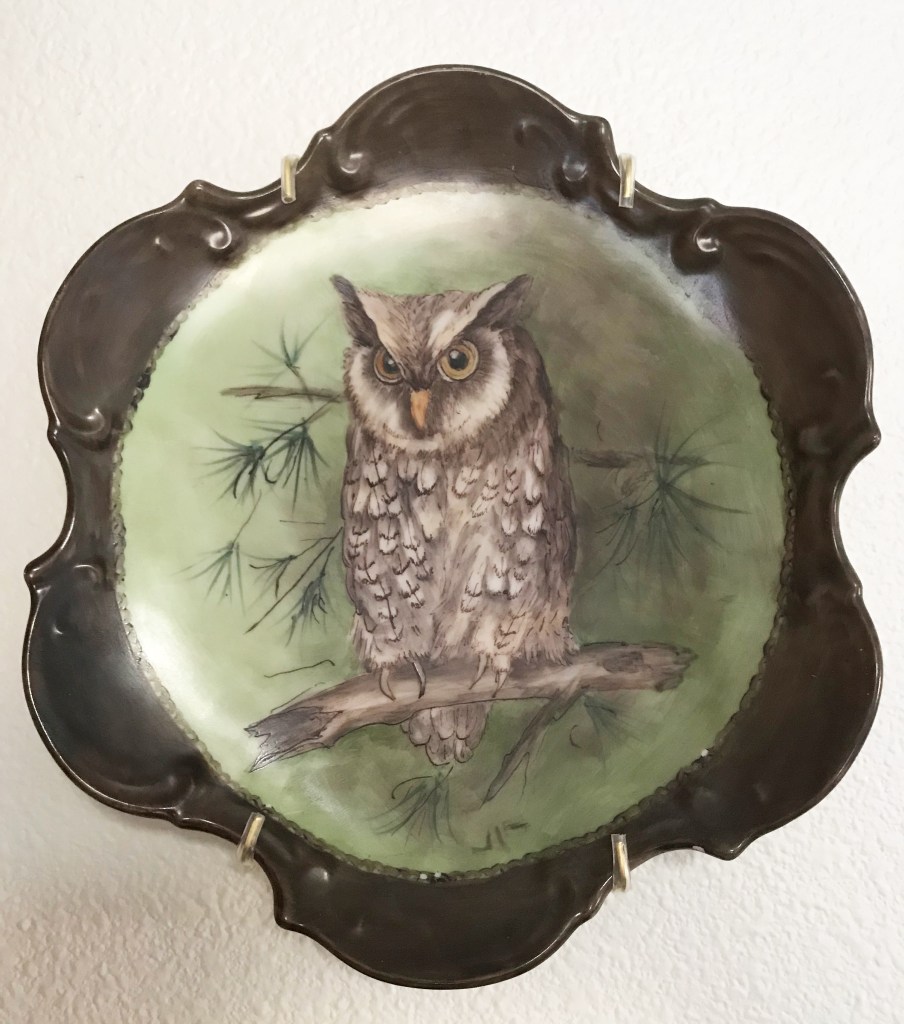
 I’ve been lucky enough to receive a couple of awards in my life, mainly for being in the right place at the right time.  I have them on my wall too, but that plate—it’s my favorite!  Rest in peace, Lilly McAnally!  (Lilly died June 25, 2020 at age 92.)
Great Possessions

If you asked me to name my favorite book, Aldo Leopold’s, A Sand County Almanac would come to mind.  This collection of observations and essays about the natural world, lifestyle ethics and membership in community is more important now than when the book appeared approximately 75 years ago.  My family is fortunate to own 20 acres adjacent to national forest property.  There is a rustic cabin, although not nearly so rustic as Leopold’s original “shack.” In the 20+ years of our ownership, I’ve kept Leopold in mind.

When we bought the land, portions of the meadow were impassable in the late summer because of invasive thistle and hounds-tongue.  Our small creek had sections trampled so badly by cattle that the channel could no longer contain heavy runoff and was becoming braided.   

The Leopold family had a bigger problem because the already poor soil had been eroded by both logging and inappropriate farming practices. In response, they planted thousands of trees.  For us, battling the land misuse was a combination of removing the cattle, keeping the fences repaired, digging, and spraying weeds, and repairing the creek channel by planting willows and using downed wood and rocks to rebuild the banks.  We saw our efforts almost immediately.  For the Leopolds, decades were required.  Their property is now a beautiful mature forest and hosts The Leopold Center a very worthy organization (The Leopold Center | The Aldo Leopold Foundation  ).  (If you are ever near Baraboo, WI, don’t miss a visit.)  We now have a natural creek channel and weeding requires only minor annual maintenance.  The fact that we had improved some damaged land helped me feel connected to Leopold.

I’ve felt that connection even more these past few months.  The covid-19 pandemic has kept us close to home and eliminated our social engagement.  But we still have our cabin!  Even after 20+ years, I continue to marvel at how rapid are the changes in wildlife and plants from week-to-week. 

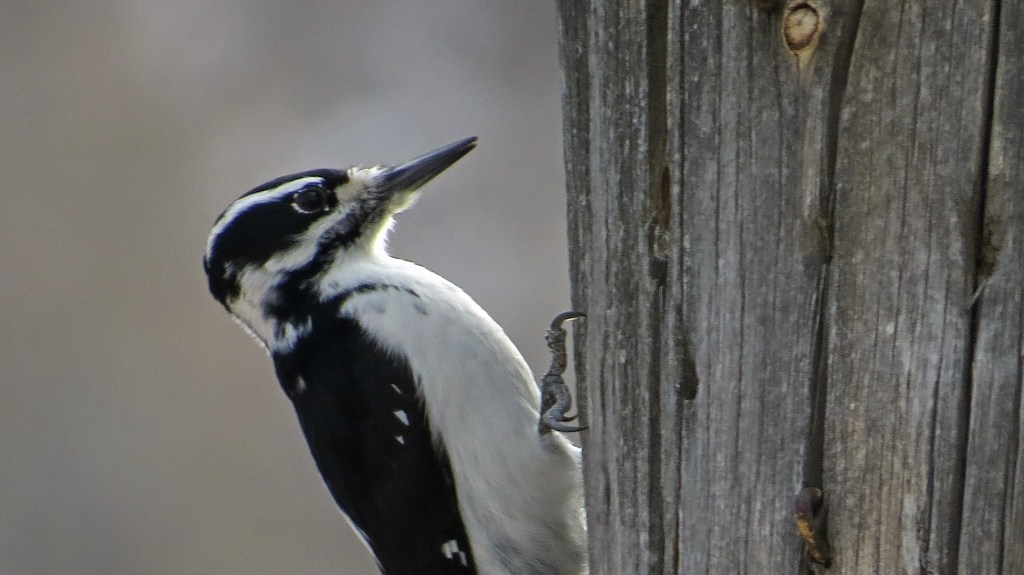
Some species, I see often, such as this female Hairy Woodpecker I photographed last week. Last February, I spent several solo days writing. Birds were scarce. A big storm hit. The wind howled. Snow blew. Temperatures dropped below minus-10.  In the midst of the storm, I heard a loud knocking on the walls. It sounded like the rhythm of a woodpecker.  It may have been the only time I braved the outdoors that day.  I bundled up and emerged from the warm cabin.  There she was, a female Hairy Woodpecker, finding insect larvae in the logs.  There’s a good chance my photo is of the same bird nine months older.

Leopold has an essay about a banded chickadee (#5290) that was recaptured annually for five years.  Doubtless, some of the chickadees I’m seeing each week are the same birds, and the same birds I saw last winter.

I’ve been able to spend more time connecting with other species too.  Early in November, I found a Northern Pygmy Owl.  I heard his repetitive toot-toot while I roamed the woods in the twilight.  A couple of weeks later, it was a Northern Saw-whet Owl that thrilled me with a  close approach and the “scree” call that led to its name.   The next morning, I was barked at by the Pine Squirrel that lives in the oaks by the road.  Least Chipmunks, abundant all summer and fall, are mostly asleep for the winter.  In fact, I thought they were all slumbering, but the one who lives under our deck has recognized that my presence means seeds around the bird feeder.  Perhaps, my walking on the deck woke him up and led to his dash for the bush that has the feeders.  Once inside the bush, I heard his familiar bark.    

Leopold, if not the inventor, was the first to popularize the idea of ecology as the inter-connectedness of all living things.  His book is replete with descriptions of everything from the tiniest flowers to the larger animals and birds.  Leopold’s working title for his book was Great Possessions, I know how he felt.

LOGGING FLUMMOXES FLAMMULATEDS

The siren wailed. I looked in the mirror and saw the flashing lights. It was two o-clock in the morning. There was no one else. They were coming for me. “Do you know why I pulled you over?” asked the policeman. “Well,” I said. “I guess I was speeding.” “We were owling,” I continued. “I’m not accustomed to being out so late and driving without traffic. I must have been careless after getting off the highway.” “Yep,” he said. “You were going 50 in a 35 zone.” But, then he mentioned that when in a youth group he had gone owling in the eastern US. He had seen Barred Owls and Great Horned Owls. I said we had been after Flammulated Owls.
After the policeman left with my license, insurance card, and registration, I looked disconsolately at my partner. “I wonder how much this will cost,” I said, as she apologized herself for not paying attention and suggesting I slow down. Miraculously, in these days when obtaining municipal revenue from all sources is so important, I was only issued a warning. Relieved, I drove slowly home.
Have you heard of a Flammulated Owl? Many people haven’t. Except for one or two species near our Southern border, “Flams” may be the least well-known owl in the US. According to several sources, while being more-or-less identically sized, they weigh less, on average, than a pygmy owl. How is something smaller than a pygmy? Flams are found in most western states but unlike most other owls, they are migratory because their most common prey items are moths. Limited research indicates their small global breeding population of 20,000 is declining.
We had started near Windy Point in Colorado’s Uncompahgre National Forest just after 9PM. Following a protocol left by my owling mentor, the late Rich Levad (https://birdconservancy.org/about-us/recognizing-excellence/levadaward/) , we stopped every half mile. We listened. We played a call, listened more and then repeated. By the time we finished our ten-mile route at Columbine Pass; it was midnight. Two owls had come in close. We heard another clearly and possibly three more distantly. Success, right?
Rich had done this route several times approximately ten years ago. One year he had ten owls, but the year he used the protocol we followed, he had 31. What’s going on? Massive logging operations, that’s what’s going on. For several miles in the middle of our route, there were stacks of logs, piles of slash and parked logging vehicles. Flams like thick, old-growth forest, not thinned, cut and disturbed. Will Flammulated Owls make it? It is up to us. The type of forests they need are almost all on public land. Nearly all federal timber sales lose money. Most analyses indicate that we taxpayers pay several hundred million per year to ensure that logging continues. Perhaps such expenditures can put the Flammulated Owls on the endangered species list. Then, the taxpayers can pay to recover them.
Flams, however, may not be so easy to recover. The limited research suggests they have a lower reproductive rate than other owls. And, at a time, when insect populations world-wide are falling, their prey-base is probably also declining.

(This old photo of a Flammulated Owl on the Uncompahgre National Forest isn’t very clear, but it shows the owl’s dark eyes. Other small US owls have lighter eyes, believed to be correlated to the fact that they hunt in the daytime or the twilight, unlike Flammulated Owls which are strictly nocturnal.)OwlOnUncompahgre Flamd