
If you asked me to name my favorite book, Aldo Leopold’s, A Sand County Almanac would come to mind. This collection of observations and essays about the natural world, lifestyle ethics and membership in community is more important now than when the book appeared approximately 75 years ago. My family is fortunate to own 20 acres adjacent to national forest property. There is a rustic cabin, although not nearly so rustic as Leopold’s original “shack.” In the 20+ years of our ownership, I’ve kept Leopold in mind.
When we bought the land, portions of the meadow were impassable in the late summer because of invasive thistle and hounds-tongue. Our small creek had sections trampled so badly by cattle that the channel could no longer contain heavy runoff and was becoming braided.
The Leopold family had a bigger problem because the already poor soil had been eroded by both logging and inappropriate farming practices. In response, they planted thousands of trees. For us, battling the land misuse was a combination of removing the cattle, keeping the fences repaired, digging, and spraying weeds, and repairing the creek channel by planting willows and using downed wood and rocks to rebuild the banks. We saw our efforts almost immediately. For the Leopolds, decades were required. Their property is now a beautiful mature forest and hosts The Leopold Center a very worthy organization (The Leopold Center | The Aldo Leopold Foundation ). (If you are ever near Baraboo, WI, don’t miss a visit.) We now have a natural creek channel and weeding requires only minor annual maintenance. The fact that we had improved some damaged land helped me feel connected to Leopold.
I’ve felt that connection even more these past few months. The covid-19 pandemic has kept us close to home and eliminated our social engagement. But we still have our cabin! Even after 20+ years, I continue to marvel at how rapid are the changes in wildlife and plants from week-to-week.
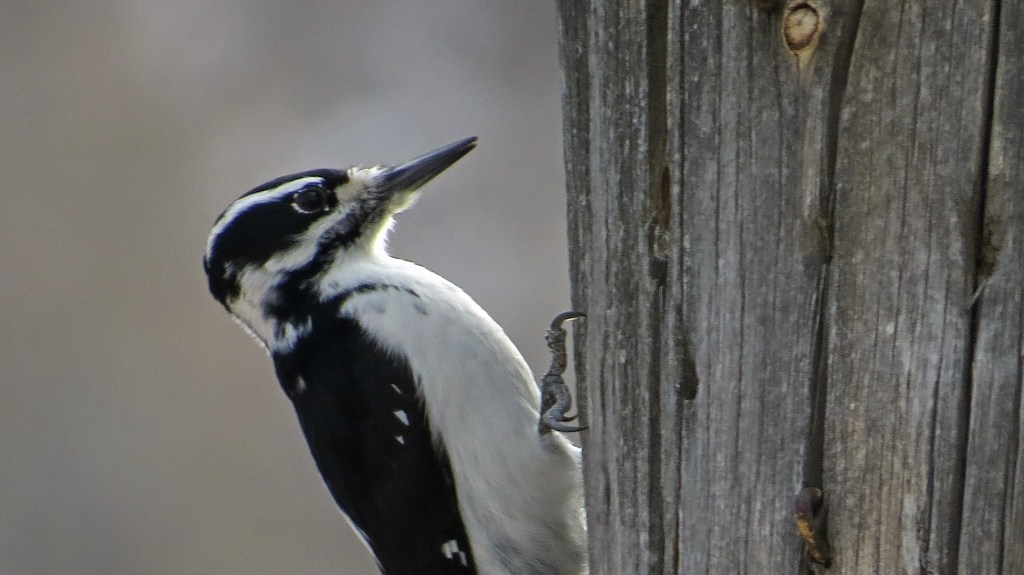
Some species, I see often, such as this female Hairy Woodpecker I photographed last week. Last February, I spent several solo days writing. Birds were scarce. A big storm hit. The wind howled. Snow blew. Temperatures dropped below minus-10. In the midst of the storm, I heard a loud knocking on the walls. It sounded like the rhythm of a woodpecker. It may have been the only time I braved the outdoors that day. I bundled up and emerged from the warm cabin. There she was, a female Hairy Woodpecker, finding insect larvae in the logs. There’s a good chance my photo is of the same bird nine months older.
Leopold has an essay about a banded chickadee (#5290) that was recaptured annually for five years. Doubtless, some of the chickadees I’m seeing each week are the same birds, and the same birds I saw last winter.
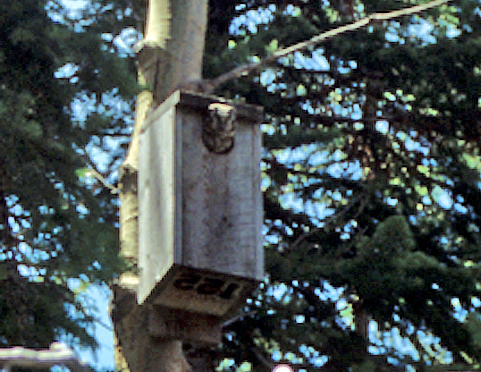
I’ve been able to spend more time connecting with other species too. Early in November, I found a Northern Pygmy Owl. I heard his repetitive toot-toot while I roamed the woods in the twilight. A couple of weeks later, it was a Northern Saw-whet Owl that thrilled me with a close approach and the “scree” call that led to its name. The next morning, I was barked at by the Pine Squirrel that lives in the oaks by the road. Least Chipmunks, abundant all summer and fall, are mostly asleep for the winter. In fact, I thought they were all slumbering, but the one who lives under our deck has recognized that my presence means seeds around the bird feeder. Perhaps, my walking on the deck woke him up and led to his dash for the bush that has the feeders. Once inside the bush, I heard his familiar bark.
Leopold, if not the inventor, was the first to popularize the idea of ecology as the inter-connectedness of all living things. His book is replete with descriptions of everything from the tiniest flowers to the larger animals and birds. Leopold’s working title for his book was Great Possessions, I know how he felt.
 Birds and More