
There is no folly of the beasts of the earth which is not infinitely outdone by the madness of men. Moby Dick, Herman Melville
Belize had never been on our radar. We had already experienced superlative snorkeling and diving in Mexico and Hawaii. Birds? With all my time in Mexico and especially Costa Rica, the few potential new species in Belize were not enough to inspire a visit. Besides, much of our attraction to the rest of Central America was the Spanish language and associated culture. Belize, where English is the official tongue, is a Central American outlier. Only one more enticement remained. We are students of Mayan ruins and have visited these ancient sites extensively in Mexico with additional trips to Guatemala and Honduras. We knew Belize had ruins, but our interest in them had never been sufficiently piqued. Then, Mexico built the train.
My hatred for the so-called Maya Train is visceral. Thinking of it nearly evokes a sob. I have described Yucatán’s interior before the train (Oxkintoch, Chacmultun, and the Center of the World). In that essay I contrasted the frenetic and over-developed coast with the tranquil interior, which a scant ten years later is being obliterated. * The Maya train connects both coasts with the interior major cities and the once less-visited Mayan sites.
Besides opening the area to industrial tourism, construction irreparably damaged the landscape. YouTube videos show that pylons supporting train tracks penetrated once-pristine cenotes. Construction disrupted lives of Indigenous peoples and bisected what had been the largest section of intact jungle, except for the Amazon, in the Western Hemisphere.
Mexico’s president at the time, Andres Manuel Lopez Obrador decreed that the Maya Train was essential for national security. The purpose of his declaration was to suspend various legal requirements for administrative procedures such as environmental impact assessments, licenses, and permits. Usual contracting procedures were bypassed so construction could start immediately. The rush to destruction was so intense that the army was put in charge of certain sections, including the one that accesses Calakmul, which with its adjacent forests has been recognized as a World Heritage Site by UNESCO.
Obrador knew there would be court challenges but by rushing construction; he rendered them moot. In some instances, official mandates requiring suspension of construction were ignored but even when the judicial system intervened successfully, it was “too late because the project had already reached an advanced stage of execution.”
These actions were consistent with the overall Obrador presidency which eliminated all government support for environmental non-government organizations (NGOs), eliminated most of the funding for Mexico’s national park service, 75% of the funding of the National Commission of Protected Areas (CONANP), and 75 % percent of the budget of the National Institute of Anthropology and History (INAH) which oversees more than 100,000 heritage and archaeological sites, museums and monuments.
We have had marvelous experiences at numerous INAH sites. We had been delighted, rightfully believing Mexico was more skillful at protecting their national heritage than was the US. No more.
Comprehending the train’s impact made us heartsick. In our minds’ eyes, Mary and I could see favorite, large, ruins such as Edzna and Calakmul overrun by tourists and vendors, while beautiful, small ruins such as Tabasqueno and Sihunchen are overrun with weeds and looted. Pre-train, up to 50,000 annual visitors enjoyed Calakmul. The post-train goal is three million.
We had been considering another trip to the Yucatan, but now it would be too painful. A recent visit to Guatemala’s Tikal, however, had alerted us to Caracol in adjacent Belize. Here was a large Mayan ruin—seldom visited because of a bad road. Internet searches verified that hiring a knowledgeable driver/guide or at a minimum, renting a four-wheel drive vehicle was necessary. This sounded perfect. We knew we needed to hurry because Lopez-Obrador had proposed to the Belizean government, as well as to Guatemala’s, that their major ruins be linked to Mexico’s train.
Our visit to Caracol was almost too late. We are among the last to have the sense of discovery and mystery that overwhelmed the first Europeans to visit. Why? The government of Belize has allocated tens of millions to install bridges and to straighten and pave the access road. Even as we travelled in early 2025, the advice suggesting a four-by-four vehicle was outdated. Most of the road was completed and the remainder of the construction was in advanced stages. Any passenger car could make the journey although the trip, for now, remains slow and dusty.
Once the project is complete, the road will be accessible to large tour buses. The Chichen Itza experience will be the norm. Chichen Itza is a magnificent ruin, but the quantity of venders and crowding is remarkable. We visited in the off-season, mid-November, and were still shoulder-to-shoulder with other tourists by mid-morning. Most structures are roped off and viewed as museum pieces. Walking the paths between edifices required passing through a gauntlet of hundreds of vendors. Some would call out. Some were listening to the radio. The flea market ambience hindered attempts to marvel at Chichen Itza’s construction and contemplation of its history. But then, what would one expect with 2.5million annual visitors? In contrast, annual visits to Caracol have been approximately 11,000. I doubt Caracol will ever attract the numbers of Chichen Itza but how much will the experience change when the annual visitation is one million or even one hundred thousand?
We were the day’s first visitors. The caretaker noticed our arrival, walked from his small hut, and unlocked the gate. Ultimately, the parking lot added a small van and three or four more cars. It was a Saturday, after all.
Mary and I enjoyed the old-Mexico-like experience we desired. We climbed the pyramids. We were able to sit quietly on one of the structures as we listened to the bubbly calls of Montezuma Oropendolas busy completing a colony of their pendulous nests over one of the plazas. We could imagine the countryside’s former inhabitants filling the plaza to view sacred rites conducted on the heights.
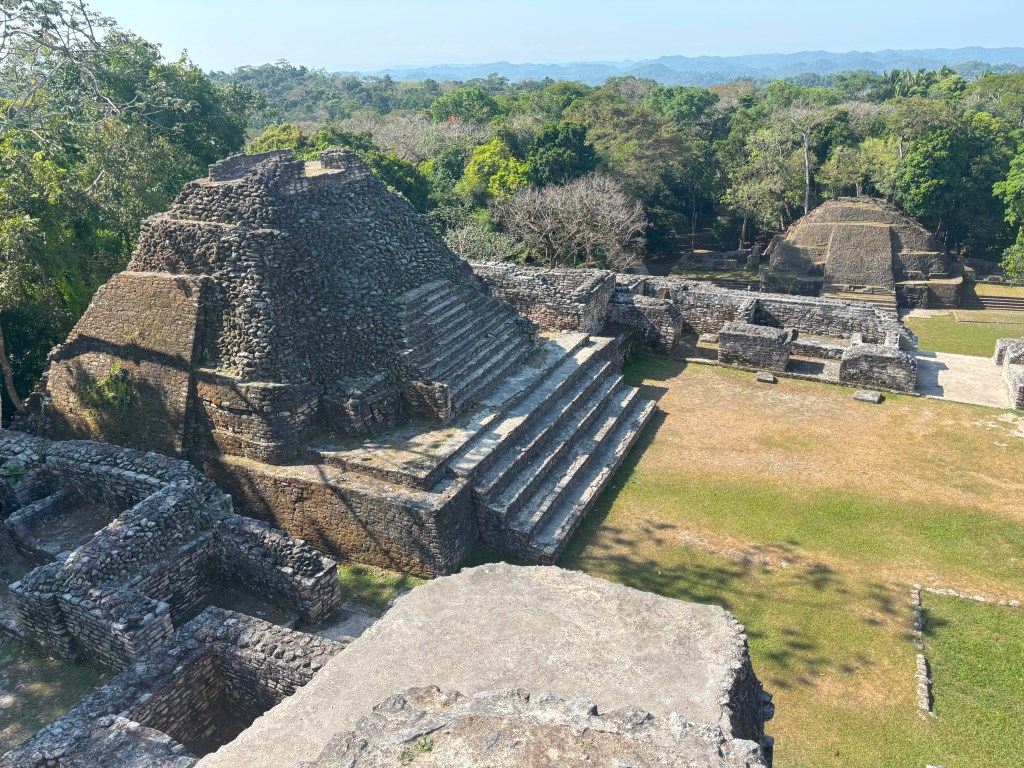
Caracol’s main plaza from the top of the largest pyramid.
We walked through rooms and hallways, trying to imagine how the people conducted their lives more than one thousand years ago. All the while, monkeys and a variety of forest birds watched from overhead.
Our base for the visit was San Ignacio (population 23,000), from where we also explored Cahel Pech and Xunantunich, two small, nearby ruins, both of which will, no doubt, experience a great deal more visitation when the road to Caracol is completed. Fortunately, we experienced these sites in the manner we desired. Now we could consider the sea.
I suspect most people envision the ocean when they contemplate Belize. Astride the largest coral reef in our hemisphere, second only to Australia’s Great Barrier Reef in length, snorkeling and diving have world class reputations, as does the expense of visiting. I credit Mary with her usual diligence in finding a suitable location for us: Tobacco Caye.
Tobacco Caye is a five-acre island with minimal square footage without a building. Our modest resort was perfectly clean and provided good food. It was not a luxury refuge, so prices were reasonable. Moreover, unlike many Belizean oceanside locations, we could snorkel directly from the dock—no need to hire a guide or boatman to take us to the reef. We were able to see a nice variety of fish and other sea life including eels and octopus. Dive and snorkel trips to famous sections of the reef were available, but we did not feel a need. For us, this was perfect for a few days of ocean.
But Belize is a prime bird watching destination, surely there were birds to find? As stated above, there had not been sufficient new species for me to pursue for the country to become a significant objective. That changed when we visited Tikal, just across the border in Guatemala. Not only had we learned about nearby Caracol, but I was chagrined when I understood that had we planned to spend another day, I likely would have been able to see three species new to me: Black-throated Shrike-Tanager, Mayan Antthrush, and Pheasant Cuckoo.
The latter two were of particular interest. Pheasant Cuckoo is listed as present in Costa Rica but is only detected every few years. There are no reliable locations. I never entertained the thought that I could see one. The Mayan Antthrush, like the Black-throated Shrike-Tanager is a regional endemic. It is also a member of the family Formicariidae, a favorite of mine because these are species that require pristine rainforest. Antthrushes, small and dark with an upturned tail, are reminiscent of rails. They fly little. Their colors are dark, the best for hiding in the deep understory they favor. Their presence signifies the high-quality habitat where one might see a tapir or a jaguar.
I had selected Black Rock Lodge for birding because of frequent sightings of my target species. As our arrival date neared, and I reviewed what was being seen, I was astonished by frequent reports of a Black and White Hawk-Eagle, a much rarer species than the others. Even more so than the Pheasant Cuckoo, this was a species I never expected to see.
We arrived at our quiet cabin noting many birds in the surrounding trees including several familiar from the US such as Gray Catbird, Northern Parula and Indigo Bunting. These seemed out-of-place amidst the numerous Red-legged Honeycreepers and Yellow-Winged Tanagers. I was also attracted by busy hummingbird feeders replete with White-necked Jacobins while also serving rarer Wedge-tailed Sabrewings and White-bellied Emeralds.
Our first afternoon included a pleasant hike, highlighted by a perfect view of a Sepia-capped Flycatcher—rare and local in Costa Rica where I once had a fleeting glimpse. Here, the bird was perched in the open, just above the trail. My view was lengthy and satisfying. Later, we enjoyed a pleasant swim in the warm Macal River as foraging Mangrove and Northern Rough-winged Swallows zoomed past our heads. Unexpected was a Social Flycatcher entering and exiting its nest on a mid-river boulder.
That afternoon, I met Isaias, the guide I had hired for the next morning. We discussed the birds I was most interested in seeing. Incongruously, the species of which he was most confident was the Hawk-Eagle. A pair were nesting in the adjacent Elijio Panti National Park. It is not an exaggeration to say Isaias considered himself to be their steward and protector.
The only access to the National Park was by hiring a guide and crossing the river. Although the crossing in a small canoe is trivial, the lack of a bridge and roads into the park likely accounts for the Hawk-Eagles’ presence. As he paddled, Isaias explained we would hike to see the Hawk-Eagle nest while hoping to encounter the other species on the way.
Isaias was right. Within twenty minutes we heard a Mayan Antthrush. Just six years ago, what we were hearing was considered a subspecies of Black-faced Antthrush. That species has special “favorite” status with me because its three-note, drawn-out whistle “keep-too-too” is one of those sounds that signifies “this place.” In this case, “this place” being unspoiled, sizable lowland rainforest. Sadly, its population is decreasing. Most notably, its song is no longer heard so often at Costa Rica’s famous La Selva Research Station, likely because encroaching development and climate change have altered the habitat.
The call of the Mayan is so different from the Black-faced, it was a wonderment they had been considered the same species until 2021. The Mayan’s song is a series of 9 or 10 piping whistles dropping in pitch.
There are physical differences as well. The Mayan Antthrush is overall rufous rather than brown and has dark rufous on the head and nape, and a rufous forecollar. Apparently, with cryptic species such as these, there was formerly a greater tendency to lump them. After all, they were dark birds with similar habits. I suspect, however, that the co-dwellers in the depths of the dark forest see the differences as stark.
We concealed ourselves and played the Mayan Antthrush’s song. The bird answered fearlessly. It circled us, never coming closer. After thirty minutes, Isais said, Oh well, we will find another. We moved on, and, later, another called nearby. Unfortunately, we had similar luck. The bird answered, hinted at advancing, but sailed down a steep slope and away. I did not have time to be disappointed because we were close to the target for the hike, the nest of Black and White Hawk-Eagles.
I was ecstatic to see the Hawk-Eagle. Although they can be found from Southern Brazil to Mexico, Black and White Hawk-Eagles are always vanishingly rare and local. As an example, the ebird database shows 23,000 sightings of the Mayan antthrush with only 8,300 of the Hawk-Eagle. By contrast, the Black-faced Antthrush, the most easily encountered of the three similar antthrushes, has 44,000. Adding to my excitement, just as we were arriving at the Hawk-Eagle nest, we encountered a mixed flock containing a Black-throated Shrike Tanager. Now peering at the Hawk-Eagle on its nest, I considered how many birding incidents are happenstance. This species would have been on my list of “most-likely not-to-see” in Central America, and here it was, truly one of the most beautiful of all raptors.
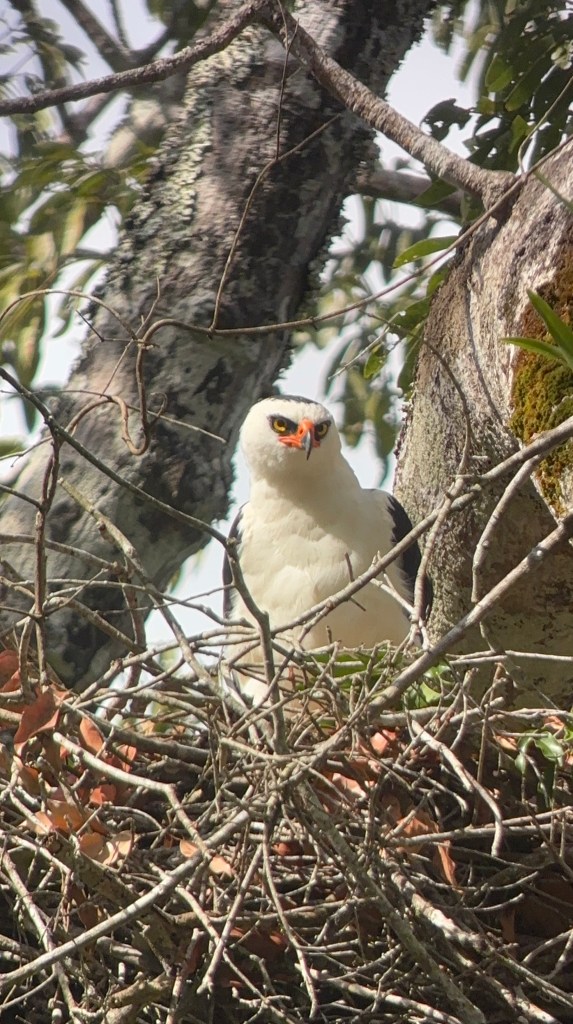
Black and White Hawk-Eagle on Nest.
Isaias was protective. After watching for a while, he said, “Let’s go, we can’t risk disturbing it. The previous nesting attempt failed. ** Grudgingly leaving the Hawk-Eagle, we turned our attention to the Pheasant Cuckoo (11,000 sightings). Black Rock Lodge had quite a few records which, ironically, besides the frequent reports of Mayan Antthrush and Black-throated Shrike-Tanager, was the reason I had selected it,
Isaias had warned me that Pheasant Cuckoo were increasingly hard-to-find once the rainy season started. Oddly, they call and are most approachable at the driest times of the year. The rainy season had definitely begun as we had already endured several downpours. The cuckoos had stopped calling. Still, we tried.
We climbed a steep slope into some drier forest, better habitat for the cuckoo. We listened and called at numerous previously successful territories, but there was never a hint of a cuckoo’s presence. I knew there had been a detection a couple of weeks before our arrival; there would not be another for a month.
Even so, it was a great hike. I saw two more Black-throated Shrike-Tanagers and had outstanding views of a pair of Tody Motmots, the rarest of the motmots. This motmot, unlike the others, does not have a split tail with bare sections, is much smaller, and typically is found in the understory. I had a sufficient, albeit brief, look at one in Costa Rica, but this viewing was far more pleasing. There was a pair, and we were able to watch them move through the forest for several minutes.
But now, it was becoming late. We had to return. Gloomily, I realized I was not going to see a Mayan Antthrush. Adding insult to this injury was that I did not even have a recording of the two we had heard. I had counted on seeing one and had not thought of it.
We had been on our feet since before six. It was now close to noon. I lamented to Isaias that I had forgotten to record the Mayan. He nodded sadly and we walked on. Suddenly, fifteen minutes from the canoe, one called. I was relieved. I quickly obtained a recording. At least now I could add its song to my birding checklist and have something to show for our attempt. I was telling Isaias I was content, but he cautioned me to be still and played his call. Inexplicably, in the middle of this searing muggy day, when it was supposed to be asleep, the bird approached. It performed a pirouette in full view. Through my binoculars I examined the wide, rufous fore collar unique to the species. The day had ended perfectly, with that last call.
*The locations affected by the train were all easily visited by passenger cars. Local guides were available. Nearby lodgings and restaurants were small, clean, and offered a home-grown flavor in both senses of the word. Hence, my objection to the train is the loss of a certain type of experience; one of quietude and tranquility amidst traditional villages. There was also an abundance of wildlife. Those cannot withstand millions of annual visitors. Would it not be desirable to preserve a range of experiences rather than offer only the industrial tourism as is already available in the Yucatan at Chichen Itza and Uxmal, and in Guatemala at Tikal?
**Three months later (July 2025), a Black and White Hawk Eagle successfully fledged from this nest.
 Birds and More
Wh
LikeLike
I enjoyed going along
LikeLike